 By admin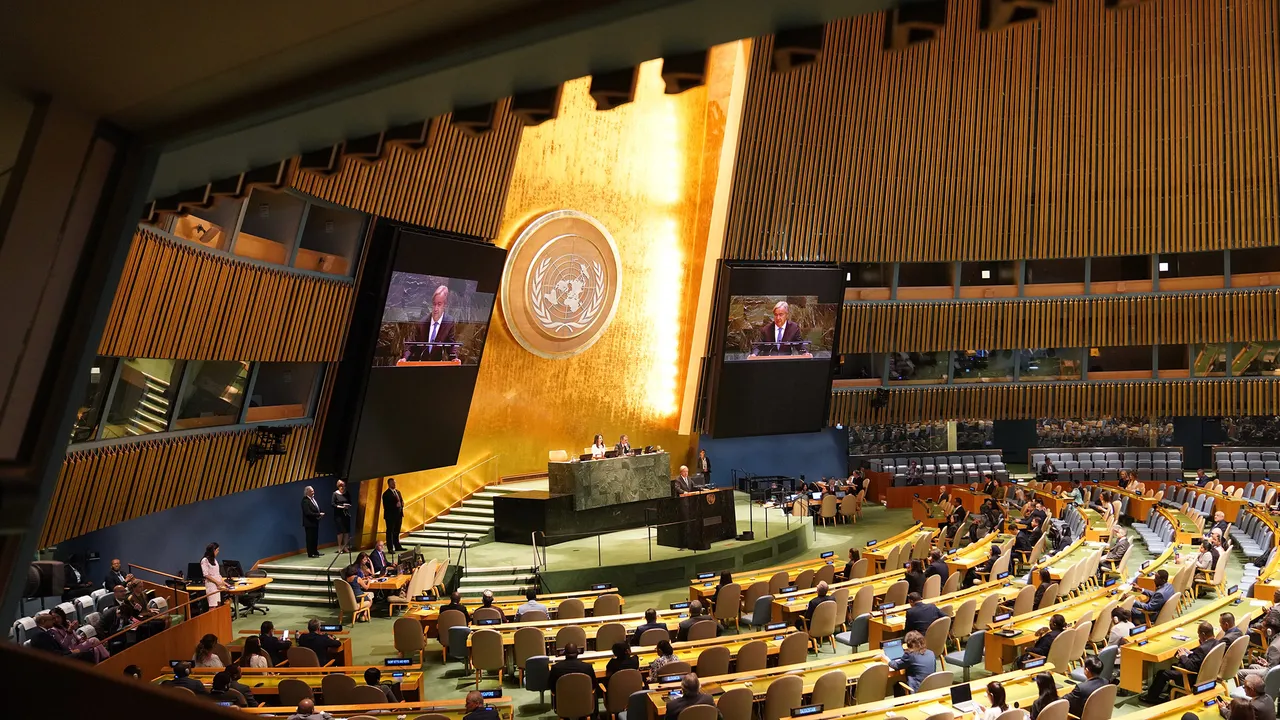
Among Washington’s think tankers and its ranks of retired diplomats, it has become commonplace to talk of the “interregnum.” The old world of the Pax Americana may be dying, to paraphrase Antonio Gramsci, but the new “post-American” order is in fitful gestation, yet to be born. After a decade of Trumpism, the United States’ closest allies know that they need to stop counting on American leadership and to start hedging their bets—and to say as much in public. Still, there’s no alternative to the status quo that was once authored and secured by the United States; China, for all its great-power designs, envisions its rise on its own terms, and it is neither equipped to fill nor interested in filling an American void. Donald Trump is at the heart of this geopolitical moment, catalytic in his alliance-fraying bullying, unprovoked warmongering, and protectionist demagoguery. Surveying the global chaos unleashed by the sweeping “Liberation Day” tariffs last year, Anthony Scaramucci, who briefly served as Trump’s White House communications director, likened the President to “an arsonist who sets fire to the house and then runs outside with the hose.” But Trumpism is also what Gramsci called a morbid symptom of the interregnum, an expression of a country riven by political polarization and by economic inequity, and struggling to come to terms with the waning of its singular status.
Read more The American Religion of Self-Storage Facilities
Next week, Trump will bring all this animus and baggage to the United Nations—an institution, which, as the embodiment of the post-Second World War order, is in the grips of an existential reckoning. For the sixth time, Trump will join in the annual ritual of the general debate at the General Assembly, where, in mostly forgettable speeches, world leaders lecture on the importance of solving global challenges together. Trump has exulted in doing the opposite, using the U.N.’s most august perch to attack its system and to mock its guiding ethos of multilateralism. Last year, he scoffed at the “empty words” that make up U.N. deliberations; panned green policies as a “con job,” while describing U.N.-affiliated climate scientists as “stupid people”; and berated European leaders in the room for letting in migrants from countries whose leaders were also in the room. Under Trump’s watch, the United States has pulled out of a host of U.N. treaties and agencies deemed antithetical to American interests, from the Paris climate accords to the World Health Organization. And it has withheld billions of dollars in dues, which, if unresolved, could lead to the U.S. losing voting rights at the General Assembly. In August, Congress began releasing a tranche of some seven hundred and twenty-five million dollars, but the U.N.’s funding shortfall has been so acute that, earlier this year, the Secretary-General, António Guterres, warned of an “imminent financial collapse.”
Guterres, a former Prime Minister of Portugal, whose decade-long tenure at the U.N. ends in December, is an emblematic figure of the interregnum. He has been unable to muster the same authority and influence as some of his predecessors, hobbled by Trump’s antagonism and by the disregard of other big powers in an increasingly ineffective Security Council, where veto-wielding member states—chiefly, the United States, Russia, and China—have stymied collective action. In his final years in the role, Guterres has had to initiate major budget cuts, slashing roughly a fifth of the U.N.’s workforce and scaling back some of its most vital humanitarian and peacekeeping operations. He has found himself reduced to a kind of global town crier, posting proclamations on social media about the dangers of a warming planet, the risk of escalating humanitarian disasters, and the failures of governments to stop wars in Ukraine, Gaza, Sudan, Myanmar, and elsewhere. His entreaties have proved sadly easy to ignore.
Trump and his lieutenants seem intent on pushing their vision for a pared-down U.N. “This institution desperately needs strong, effective leadership,” Mike Waltz, the U.S. Ambassador to the U.N., said, during a Senate briefing this spring. That, in his view, means appointing a figurehead who will embrace U.S. priorities, including defunding programs whose focus is distinct from the “basics” of “peace and security.” Attention now falls on the race to succeed Guterres, which includes a crowded field of mostly Latin American officials. The Trump Administration hasn’t signalled a preferred candidate yet, but it will almost certainly veto more progressively minded contenders, such as Michelle Bachelet, a human-rights advocate and the former President of Chile, whom Republican lawmakers cast as a “pro-abortion zealot” in a letter to Marco Rubio earlier this year. Anjali Dayal, a professor of international politics at Fordham University and a longtime U.N. watcher, is concerned about a future leader whose ambitions for the United Nations get hamstrung by the projects and whims of the great powers. “The U.N. could face a kind of reduction toward obsolescence,” she told me. “In ten years, we could have a vestigial organization that doesn’t really serve many purposes in the world.”
A generation of U.N. dignitaries, like Guterres, believes in a post-Cold War internationalism, which, at its core, assumed that everyone understood that the world’s problems transcend borders and require shared solutions. That’s not, of course, how this White House sees things. It delights in being the king of the jungle. It dismisses the idea of a rules-based order or of any prevailing system in which countries can take American support for granted. It cheers nations, such as Poland and Japan, that are building up their defense capabilities and urges others to follow suit, even if that means gutting social-welfare programs. In an interview with the Times, Elbridge Colby, the Under-Secretary of Defense for Policy, said that the Administration is moving beyond “the liberal international-order delusion” and returning “to the Cold War idea,” which entails “going back to the basics of building military readiness.” The U.N. once led global efforts to stop nuclear nonproliferation; now, amid the havoc of wars in the Middle East and the uncertainty posed by Trump’s actions, countries as different as Turkey and South Korea are contemplating building their own atomic-weapons programs.
Read more How, Exactly, Could A.I. Kill Us?
“Our world is at risk of becoming a gangster’s paradise, in which rules matter far less than they once did—and raw power matters more,” Hal Brands, a professor of global affairs at the School of Advanced International Studies at Johns Hopkins University, wrote in Foreign Policy. And Trump is troublingly well suited for the role of boss in such a world. His family enterprises are already intertwined with the White House’s foreign policy. He has shown greater willingness in his second term to coerce and bully long-standing allies than to confront putative adversaries. His imperial appetites are diverse: he has set about transforming Venezuela into a vassal petro-state, but still clings to visions of annexing Greenland and sees the renaming of bodies of water in America’s vicinity as acts of triumph. It’s the sort of erratic behavior that makes the country look like a rogue hegemon. According to recent polling by the Rockefeller Foundation, respondents in twelve out of sixteen developing countries surveyed, including Indonesia, Brazil, and Mexico, ranked the United States as a greater threat to their nation than either China or Russia.
Repeatedly under Trump, the United States has found itself either alone or in a tiny minority on certain U.N. resolutions—including General Assembly votes against a call for a ceasefire in Gaza and a resolution recognizing the horrors of the transatlantic slave trade. It was the lone voice of dissent among dozens of countries in a U.N. commission focussed on expanding efforts to support women’s rights. Earlier this summer, it was one of just ten countries, including North Korea and Russia, that voted against giving Volker Türk, a respected Austrian lawyer, a second term as the high commissioner of the U.N.’s human-rights agency, purportedly because he had been critical of the United States and Israel. “The US used to be a beacon of human rights,” France’s U.N. mission in Geneva posted on social media, in a conspicuous broadside. “Not anymore. Today, it stands alongside North Korea, Nicaragua, Mali & Russia, isolated. And the world no longer listens to it.” (The Trump Administration punished France for that post, suspending the approval of a new French ambassador to Washington for weeks, until authorities in Paris offered a timid apology.)
Last week, Annalena Baerbock gave her final address as the outgoing president of the United Nations General Assembly. “To those out there who argue that the U.N. is irrelevant or failing,” Baerbock, who previously served as Germany’s foreign minister, advised, “I would simply say: consider, for just one minute, the alternative, a world without the United Nations.” That would be a world, she argued, where millions of children would not have the schooling provided by UNICEF, where tens of thousands of families would be shorn of humanitarian assistance, where myriad communities would be plunged back into the horrors of war because of the absence of U.N. peacekeepers. Without mentioning Trump by name, Baerbock implied that his animosity was having a rallying effect. “The power games of our times and the direct attacks on this dear institution have in many ways brought the vast majority of this General Assembly closer together,” she said.
Comfort Ero, the president of the International Crisis Group, told me that, while we shouldn’t “romanticize the old order,” the U.N. system is still the best that nations have for dealing with one another. No other architecture exists, she noted. Newish geopolitical blocs, such as the BRICS+, a grouping of mostly Global South nations which includes China, India, and Russia, don’t position themselves in opposition to the U.N. system but as an outgrowth of it. Guterres, who attended the bloc’s summit in New Delhi this past weekend, has urged reforms to the U.N. that reflect the new demographic and geopolitical realities of a “multipolar” world. “This may be the worst time in the life of the U.N., but it’s not the time to write an obituary,” Ero said. “It’s diminished, but it’s not dead.” And what comes next is still far from view. ♦
Read more Updated Jane Austen Titles