 By admin
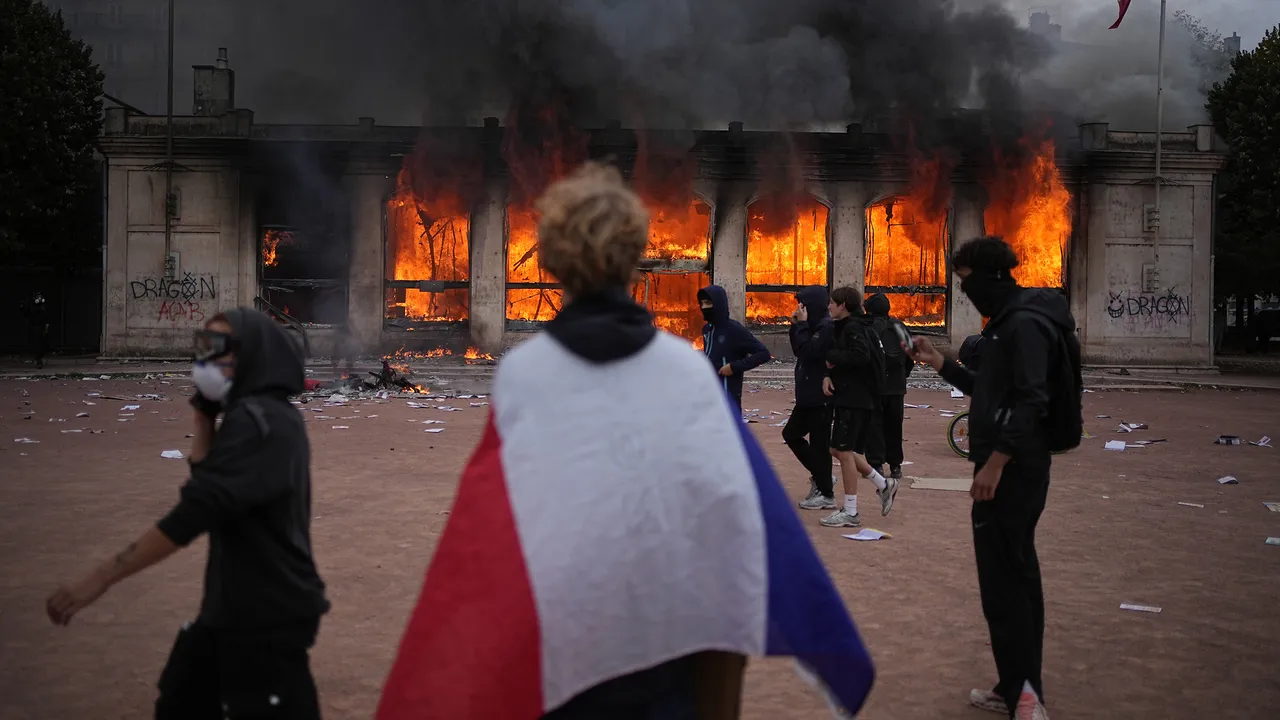
Last weekend, mass riots erupted across France after weeks of protests by lycée students over underfunding and poor conditions in their schools. As the demonstrations grew, they expanded to include other groups, including those upset with the cost of living and the Presidency of Emmanuel Macron, and rioters looting property and setting fires around Paris and other French cities. Macron’s second term ends next year, and even before the violence of last weekend, Marine Le Pen, the leader of the far-right party known as the National Rally, was, according to polls, his most likely successor. That appears to be even more true now, with Le Pen’s final-round opponent now likely to be Jean-Luc Mélenchon, a left-wing politician who has associated himself with the protest movement but who is also radically unpopular in the country at large.
Read more Spooky-Season Theatre to Chill You to the Bone
I recently spoke by phone with Julian Jackson, an emeritus professor of modern French history at Queen Mary University of London, and the author of a number of books on French history, including the definitive biography of Charles de Gaulle, about the situation in France. During our conversation, which has been edited for length and clarity, we discussed what the riots mean for the political future of the country, why Macron’s Presidency is ending disastrously, and whether the riots will be understood as a hinge point of French history.
How much are the youth protests important in and of themselves, and how important are they because of what they symbolize about the state of the country?
That is a good way to think about it, because some events become important for what they represent, and these events are important because of what they reveal about a whole mass of anxieties and discontent in France today. But I think their importance has now become qualitatively metamorphosed, or changed, by what happened on Saturday with the rioting. So I think that’s created a qualitative change. We have moved from a protest that is revealing a lot of anxieties of the younger generation—and not just them, but also older generations—into a whole questioning about the functioning of the state or the government. I remember reading something saying that there will be a “before October 17th” and an “after October 17th.” And I think that may be slightly overdoing it, but it certainly transformed the political landscape.
You are referring specifically to the amount of violence that night?
Yes. But not just the violence. There was also the sense that the state was completely taken unawares and just had no control. It was like there was almost a void. There was a similar mood in 1968, actually, when de Gaulle’s No. 2, Édouard Balladur, described how he just had a sense that the state wasn’t able to do anything. And so I think there was that sense of a sort of void on that night, because people do need reassurance that they can be protected—their property and their lives. I was at a dinner party that evening just by chance, in Paris, and they were all, I think, fairly centrist, maybe slightly right of center, but totally not extremist people. And it was striking how one of them in particular was in a state of almost apoplectic fury. It was a bit like the way that some people wrote, after the Paris Commune of 1871, that this was a kind of Saturnalian, orgiastic, obscene uprising. And he talked in the same sort of language, that these people should just be shot. He meant the rioters, not the students, but what it showed me was a sort of class panic, a social panic, that that night created. And everywhere you go in France, people are terribly worried now about what’s going to happen next.
You are suggesting that this could be seen as a hinge moment, and my first thought was that you meant it will be the moment when everyone looks back and says that this was when they knew Le Pen was going to come to power.
Yeah.
And then, when you were just describing that dinner party, I thought to myself, this is also going to be a reason, perhaps in their own minds, for people like that—centrist to right-of-center—to justify taking this giant step and voting for Le Pen.
Whether or not it’s pulled down the last obstacle to a lot of people accepting the idea that they could vote for this party or not, I think you’re right. I still won’t say that Marine Le Pen is definitely going to be elected. They’ve got six months to go, and a lot of things can happen. But obviously if you’re putting money on it, she will be elected, and the chances have obviously increased hugely as a result of what happened, not only because it will frighten people into voting for her but also because the only other person who’s been audible, really, in this moment is Mélenchon, on the extreme left. He had lost a bit of traction over the last two years, I think because of a number of things, partly because of antisemitism and partly just because he did seem to be slightly losing it and slightly a figure of the past. But this has definitely reinvigorated him.
And he obviously can’t defend the pillaging and looting on Saturday night, but he’s very clever. He says when he’s asked, Well, I’m not the government. It’s not for me to make a comment on that. I’m going to say that I think the students are at least legitimate in their demands, and I’m completely with them, and I will demonstrate with them. And it’s not for me to comment on the violence because that’s something the state should deal with. And it’s obviously a completely devious answer.
But what’s very interesting is that what you might call the centrist politicians have almost been completely inaudible over the last few days. They just don’t know what to say. So, yes, I think it is a radicalizing moment, but in both directions. I think it will win Mélenchon new support and win Marine Le Pen new support. So I agree with your skepticism. Who knows whether it’s a turning point, but it sort of feels like that at the moment.
And the way the French election works is that there’s a first round for the Presidential contenders and then the two front-runners go forward. And Le Pen is polling well against the centrist candidates in a possible final round, with small to medium leads. But she beats Mélenchon by over thirty points.
Absolutely. And all I would say about that is that if, and it is an if, a centrist candidate does get to the second round, at that point there’s a chance they could be in a position to actually win six months down the line, but we don’t know how long the impact of what happened on Saturday is going to go on because there are more demonstrations coming up, obviously. I had the sense, talking to people, that they’re living on a volcano and they’re sort of tiptoeing around, knowing that the government’s paralyzed, and it can’t do anything, so they just wait till the Presidential election. And there’s this sort of strange, ghostly expectancy, which is quite weird, a mixture of apprehension and fear.
You said the centrist candidates, from the socialist center-left to the center-right, seem somewhat paralyzed. Why?
Well, Mélenchon has been with the lycée a hundred per cent from Day One, they love him, and Le Pen basically says, We need order. Meanwhile, the centrists are not sure where to situate themselves. If they go too close to the school protesters, they seem to be legitimatizing disorder, but then if they go too close to supporting everything the police does, that is a problem, too. It is the classic problem of centrism when the two extremes are so voluble and actually convincing to their own constituencies, and also some of the centrists were in Macron’s government, so that is also a problem for them, and it is difficult for them to find their voice.
And the reason for that is that the one thing you cannot underestimate at this moment is the cold contempt everyone has for Macron. I have not met a person who has anything good to say about Macron. Actually, I had lunch with one of his ministers the other day who obviously did say good stuff about him. But beyond that, it’s almost impossible. And, of course, the picture people have of Macron at one level is a rather authoritarian figure telling people what to do, a sort of vertical President. But then another, a vertical President who simply has no power. He’s the worst of both worlds.
Read more Can Justin J. Pearson Win in Tennessee?
I was about to say he seems helpless, but people also think he’s a top-down–
They’re right; he is. But unfortunately, without being able to do anything, because there are no levers to pull any longer, which is a very sort of strange situation.
Saying the only person you met who likes him is a minister of his reminds me of the Onion headline, “Dukakis Wins 80 Percent of Dukakis Family Vote.”
Yes, absolutely. I remember that actually.
I remember something people were saying four or five years ago, maybe around the second time that Macron fought off Le Pen, in 2022, that basically Macron has had incredible political success, and he will have been President for ten years, but at the same time, he’s killed off the center right and the center left and not provided any alternative. And so you’ve had this chasm that, when he leaves, is going to exist. I remember political analysts saying that five years ago, and it seems like sometimes political analysts say things that turn out to be true and sometimes it turns out to be not true. But it turned out to be exactly right.
I completely agree. I have written something along those lines myself in various pieces about Macron. And I think I must have written five years ago myself that the tragedy of Macron, really, who did seem to offer something, was that he either seemed indifferent to or incapable of thinking about the succession. If you want to take a contrast with a President who he resembles, Valéry Giscard d’Estaing, who was also a centrist liberal, but who really did make efforts to build a center party between the Gaullists and the left. And Macron simply has either not bothered to do it or failed to do it. I don’t think he’s particularly bothered to do it. And what’s so striking is that whenever he’s had a prime minister, he immediately sets out to undermine that person who should be a credible successor.
Macronism was always going to be strange because it does move from the center left to the center right. Some of the people under the Macron umbrella are really very far right, and the people on the left are not very far left, but they’re certainly not far from the Socialists. So he had succeeded, but he only succeeded in bringing over individuals. He was never interested enough in a structure. You know what people jokingly said about how his movement was originally called En Marche? And people said, typically, that the initials of the movement were his own initials.
I think Macron both profited from the weakness of the political parties, first the Socialists and then the Gaullists on the right, and also hastened it, as it were. And he created no alternative future. He also really did show too much contempt in the early days for what the French call intermediary organizations. He sort of thought it was just him and the people. So, trade unions, local mayors, local associations—he was terribly dismissive of those sort of civil-society organisms that can actually make it possible to get things done. Admittedly, I started off as an admirer, and I had great hope, like so many people. I think he’s politically been brilliant at exploiting the possibilities of coming to power and then disastrous at knowing what to do with it.
We have talked a lot about Macron, and almost all of the things you’ve said about his failures are essentially character flaws or political errors based upon his character flaws. How would you define what his agenda was, and to what degree his policies were failures or not failures, too? Because France is obviously facing what a lot of people think is a pretty calamitous budget situation going forward. And you do hear some people blaming him for it. You say other people say, No, he tried his best; he raised the retirement age. But I’m curious how much you think his failures were, in fact, mostly personal and how much they were also policy-based.
Well, I think it seems to me incontrovertibly the case that the French need to deal with their issue of the pensions and that he was absolutely right in what he wanted to do. I think he was a liberal, he was a left liberal, a liberal in the European rather than the American sense, and he wanted a degree of deregulation, but with slightly leftist social rhetoric. It was a kind of Blairism, you might almost say. So there was something attractive and plausible in the agenda. But the Yellow Vest movement started after a gasoline-tax increase. And then it was done for good.
He had framed the gasoline-tax increase as an environmental policy. But of course, he wasn’t prepared for the reaction in any kind of way. And what he never thought of was that the people who were going to be most hit were not the sort of urbanites who believe in environmental protection in Paris but people living in deprived areas who desperately needed their cars to get to work. And so it’s almost as if he has this sense of detachment from what France really was. I also think he made a very big error at the very, very beginning. He said, Well, it’s going to be a regime. I’m going to encourage entrepreneurialism and a “startup nation,” all that kind of thing. But one of his first measures was to abolish a redistributive tax, and that was a really bad symbol that announced, I’m the President of the rich.
And it was so badly judged because it wasn’t going to liberate the economy. It was a handout, really, to the richer segment of the population. And so I think he had some perfectly good ideas. People of the socialist left would not agree with that, but I, as a centrist Social Democrat, think that he had perfectly good ideas. But the problem isn’t the ideas. The problem is his disconnectedness. Remember, he had never been elected to anything before becoming President. He didn’t have that feel for France. I don’t know whether you saw, but he made a very revealing comment to the French writer Emmanuel Carrère a bit of time ago. He said, “I was never a teenager,” which is an extraordinarily revealing comment, actually.
Also slightly disturbing given his romantic history, but we can leave that alone.
Yes, yes.
I want to ask you about de Gaulle because you wrote a really astonishing biography of him. There are obviously a lot of differences, but there are a lot of similarities: rising above the established parties; coming to power as this figure above politics, in some way; staying for ten years in Macron’s case, eleven in de Gaulle’s case; student uprisings at the ten-year mark. So anyone can come up with the similarities. But what struck me especially from your book is that de Gaulle was also just a very strange figure who would try to make these, in the Macron phrase, Jupiterian decisions. De Gaulle could be almost dictatorial. He could be authoritarian. He would sometimes remove himself from politics in strange ways and make decisions that no one could understand. And it almost felt to me, after reading your book and watching Macron, that Macron was sort of self-consciously trying to do this, but it just didn’t work in his case.
I think you’re right. I think that is how he pitched himself. Each President has an official photograph of themselves, and Macron’s has him with de Gaulle’s war memoirs in the back. Macron came after the failed Presidency of François Hollande, who said he wanted to be a normal President. And in a way, the problem is the Fifth Republic doesn’t really quite allow normal Presidents, and you’ve got to somehow inhabit the role. He did want to reëstablish the idea that the President of the Fifth Republic needs to have a certain weight and so on. He talked about verticality and about being Jupiterian. That’s all Gaullist. And what I said about ignoring intermediary institutions, very Gaullist. But of course what he didn’t have is what nobody could have really, which is that de Gaulle could do this with all the history that went with being de Gaulle in 1958, when he came to power. Macron arrived with a history of being a palace special adviser and a Rothschild banker. De Gaulle could do this because he had all the weight of legitimacy that came from being de Gaulle. I don’t say that Macron’s a lightweight, but he simply couldn’t do that. He couldn’t be that.
I’m quite lucky you haven’t asked, but usually people ask me the question, What would de Gaulle do now? And I always say to them, it’s such a stupid question because he was a man of his own time, and what de Gaulle would think about #MeToo or A.I. or the environment, who knows? But the great thing about de Gaulle was his extraordinary pragmatism. He was very adaptable despite his strangeness. But with Macron, I think he was preparing himself to reinvigorate the institutions that de Gaulle created, but failed. ♦
Read more The Fragile Unions of “Possible Love”