 By admin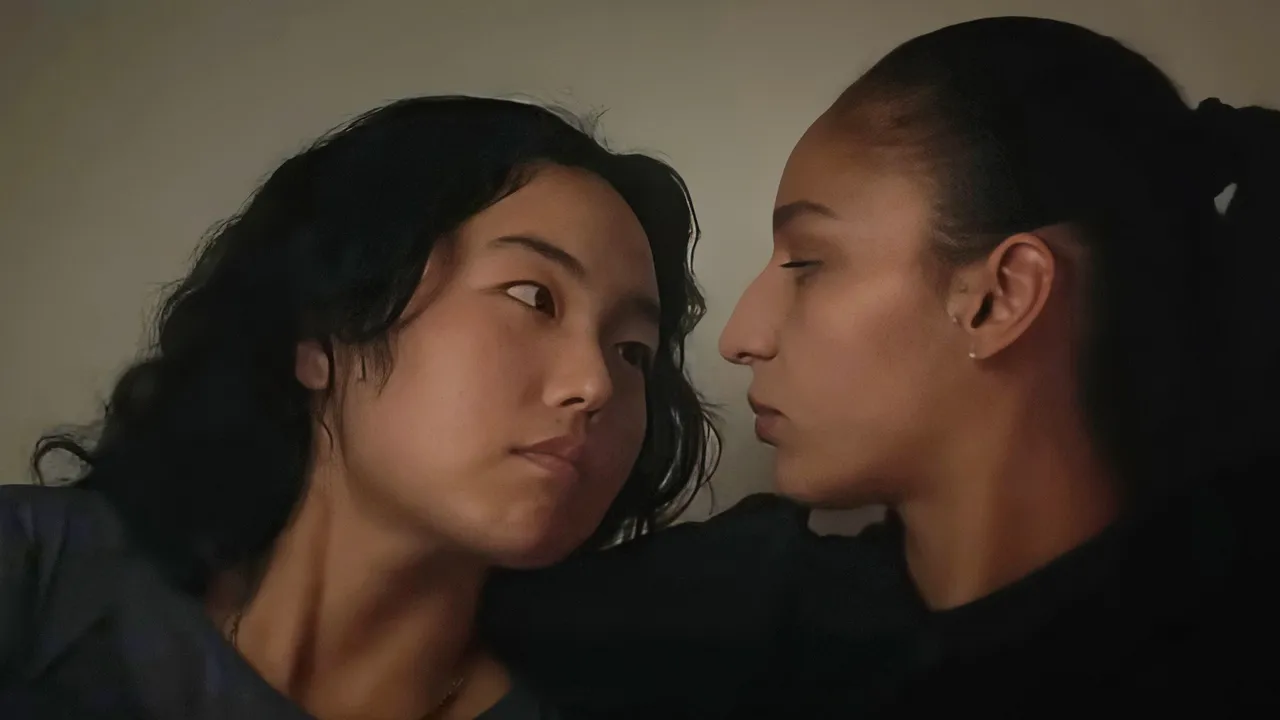
Modernity is infrastructure, and the writer and director Hafsia Herzi’s film “The Little Sister” is, in this regard, distinctly modern, even as its style and form follow a long-established tradition of humanist realism. Adapted from “The Last One,” a largely autobiographical novel by Fatima Daas, it’s centered on a high-school senior, also named Fatima Daas (played by Nadia Melliti, a first-time actor), who lives with her parents and her two older sisters in an apartment complex in an ethnically diverse suburb of Paris. Fatima is a good student and an enthusiastic, if solitary, athlete, a runner and a soccer enthusiast who kicks a ball around, all by herself, in the building’s front yard. Her fashion sense is athletic, too—track suit, no makeup, hair pulled back. She has a sort of platonic boyfriend (Ahmed Kheloufi), a serious young man who wants to marry her as soon as she graduates—even as he complains that she should dress “more feminine.” But Fatima is attracted to women, and, soon after he proposes, she acts on her attraction for the first time, by signing up for a lesbian dating app.
Read more I Need a Critic: June, 2026, Edition
At school, Fatima passes through a veritable gantlet of sexualized discourse. Her best friends are boys, and, hanging out with them outside the building before the bell rings, she listens to their macho posturing about hookups and the homophobic banter that goes with it. In class, the teacher seeks a volunteer to give a presentation on Oscar Wilde and “The Portrait of Dorian Gray,” which gives rise to more anti-gay snark. Right after class, a boy calls Fatima a lesbian, and a fight results, prompting her to suffer an asthma attack.
The following scene, of Fatima visiting a pulmonologist, is, in a peculiar way, the highlight of the movie. Nothing dramatic takes place, but Herzi nonetheless invests the appointment with great emotional weight via the scene’s unusual length, elaborate dialogue, and spare but keen visual concentration. Watching the pulmonologist character, Dr. Prévost, I was sure that he was no actor but a real-life doctor speaking to the actress as he would to a patient. (I guessed correctly—he’s played by Pascal Chanez, a professor of pulmonology in Marseille.) Dr. Prévost opens with an ordinary but probing question: did anything stressful happen that may have caused the asthma attack? Fatima says no, even as her thoughts are obviously brought back to the fight and what caused it. While discussing lung inflammation and the importance of an inhaler (and administering a breathing test live onscreen), the doctor asks Fatima whether she smokes, and invites her to a session of so-called Asthma School, where, under his guidance, young patients can discuss the practicalities of living with the disease. What Herzi dramatizes is a vision of medical care as psychotherapy by proxy, inextricably intertwined with the most intimate details of a patient’s private life. This doesn’t necessarily mean that secrets are divulged in the examination room, but that the patient herself is brought to self-awareness. Soon after the doctor’s appointment, Fatima turns down the marriage proposal and goes on her first date with a woman.
The movie spans about a year, in the course of which Fatima passes her baccalaureate exam (with honors) and begins commuting to university in Paris. In a philosophy class, the professor offers a lecture on the concept of emancipation, as exemplified in the work of the sixteenth-century writer La Boétie. Fatima, who’s of Algerian descent, is a practicing Muslim; she’s seen praying several times throughout the film, and when her faith is shaken by romantic turmoil, she consults an imam. Both of these characters are played by real-life professionals, the professor Ahmet Insel and the imam Abdelali Mamoun; for that matter, Fatima’s high-school literature teacher, in whose class she read Wilde, is played by the real-life high-school teacher Julie Chaintron. In deploying these real-life counterparts to the movie’s fictional professionals, Herzi yields the screen to their experience, expertise, and character, offering not just persuasive dramatic depictions but a kind of intellectual realism—the mental infrastructure of everyday life.
There’s another realm of knowledge which quickly takes its place in the drama, too, this one involving Fatima’s first date, with an older woman named Ingrid (Sophie Garagnon). At Fatima’s request, they park at a remote location, which Ingrid at first takes as a prompt for a quick hookup. But it turns out that Fatima, who has connected with Ingrid under a pseudonym, wants somewhere they can talk. Fatima asks Ingrid about her own self-recognition as a lesbian, and then asks for detailed lessons—spoken, not performed—on lesbian sex. The date is a form of education; in a sense, Ingrid’s role is continuous with that of the other trusted authority figures through whom Fatima is informed and enlightened.
Read more Maggie O’Farrell and the Art of Inventing the Past
What emerges is a notion—perhaps more commonplace in the explicitly multicultural U.S. than in France—of homosexuality as not just a practice but a way of life, an identity, formed in part out of the social opposition that queer people still face by way of religion, family, and the weight of tradition. That sense of identity arises all the more clearly in scenes of Fatima’s encounters with other lesbians: in the shock of recognition that passes between her and a nurse (Park Ji-min) at Asthma School, or in a charged meeting with a classmate’s older cousin (Mouna Soualem), who is instantly certain that Fatima is gay and scoffs at her denials.
As a genre, “The Little Sister” is a psychological thriller, even a film noir: a tale of a double life, which Herzi constructs with a watchmaker’s precision and an analytical clarity that distinguishes Melliti’s starring performance all the more. There’s a world of warmth surrounding Fatima—a tight-knit but not smothering family, caring teachers, sincere friends. The imam and the doctor are wise and compassionate. But Fatima isn’t ready to submit herself to judgment or opposition; she’s startlingly two-faced, her life radically divided. At home, in the neighborhood, at school, and with classmates, she’s tautly guarded. In queer circles (bars, parties, a Pride march), she cuts loose in her body language and facial expressions, bursting out with something like joy.
Herzi presents Fatima’s experience in solid blocks of self-contained and emblematic scenes that, in a film of ideas, signify ideas—sometimes all too well, at risk of feeling generic, merely illustrative. But the core of the movie is Fatima’s presence in closeup shots, which find her nearly stony, hauntedly pensive, both deeply vulnerable and bearing a defensive mask of opacity. Her fine range of seemingly similar expressions is alive with a torrential variety of emotional currents that she both conceals and protects.
Melliti is utterly untrained as an actress. Like Fatima, she is of Algerian descent, grew up in an apartment complex in a suburb of Paris, and was a teen-age athlete, a soccer player. After high school, she entered university to become a physical-education teacher, and was far along in her studies when a casting director working with Herzi spotted her in Paris, spoke with her about the movie, and asked to take her picture. Herzi was instantly taken with the photo of Melliti and, after auditions, offered her the role. Remarkably, Melliti’s personality converged with the role in surprising ways. According to Le Monde, she said “nothing to anyone, neither to her mother, nor to her brothers and sisters, nor to her friends,” about being cast in the movie and acting in it, until the day she left for Cannes, for the film’s 2025 première. As Melliti explained, “That’s how I am in life: I don’t like revealing my processes.” In that sense, she was already embodying aspects of her character before the camera ever rolled. The result is a cinematic Möbius strip joining performance and reality, the expressivity of concealment and the essential inward unity behind a double life. Through Melliti’s performance and Herzi’s alertness to her personality, “Little Sister” fills the screen with the passionate physicality behind inner life. ♦
Read more Cowboy Heaven, in MOMA’s Westerns Series