 By admin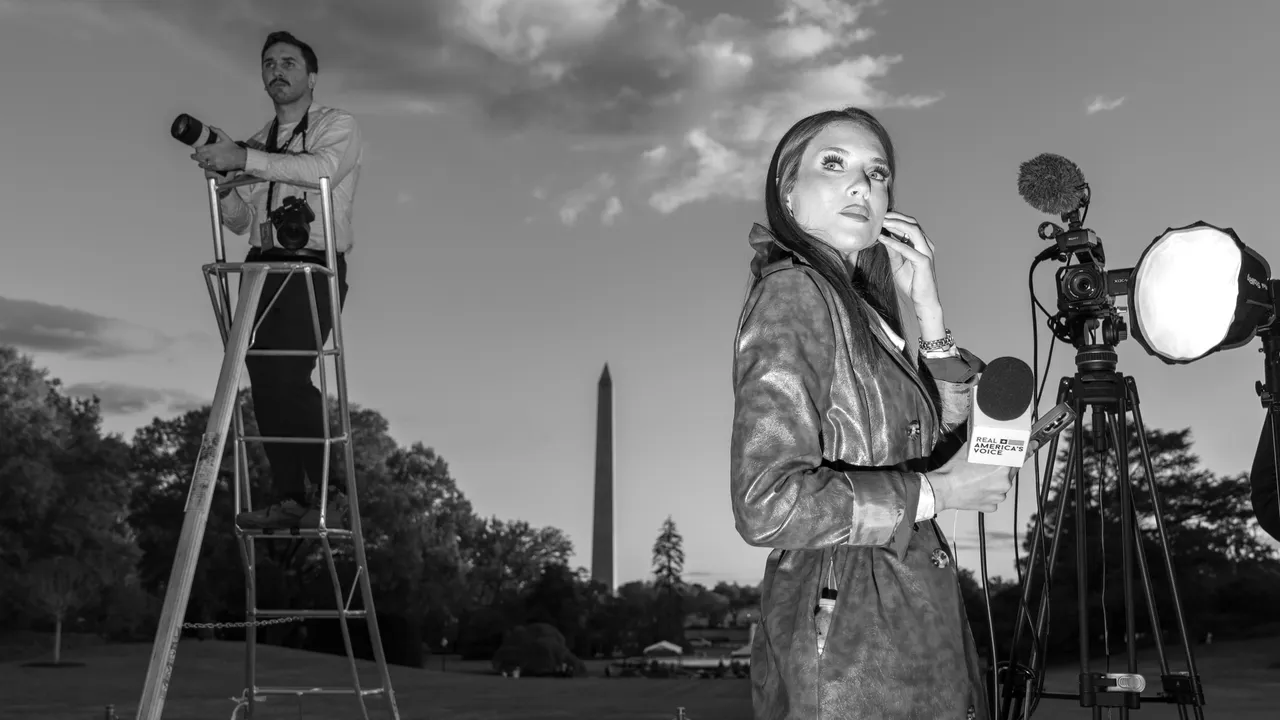
In one of Kent Nishimura’s photographs of the White House press corps, which The New Yorker commissioned, the correspondent Beni Harmony readies herself for a segment featuring the President and the First Lady. She’s covering a 2025 Halloween event; her face, which is illuminated by an unseen source, has a waxy, flashlight-under-the-chin quality. The Washington Monument rises flimsily in the background, visually echoing a rickety ladder on which a photographer perches, wearing an uncertain expression as he looks in the same direction as Harmony. The image could be a still from a film about an alien invasion, although the ominous light almost makes the figures seem like cinemagoers transfixed by something unsettling playing out onscreen. The poet Rosemary Tonks once described movie theatres as places “where the criminal shadow-literature flickers over our faces.” Harmony’s features appear to have been darkly ignited by the Trump Show.
Read more The Kinky Comedy of “I Want Your Sex”
Nishimura, now a staff photographer with Agence France-Presse, has been documenting American news and politics for more than a decade. He started reporting on the White House at the tail end of Trump’s first Administration and stayed on through the Biden Presidency. Before what journalists often refer to as Trump 1.0, he told me, New York was considered the center of the journalistic world. The landscape shifted when a genius of attention-capture broke out of reality television and into a different type of celebrity. Between 2017 and 2021, outlets ramped up their White House coverage and freelance photographers poured into D.C. When Trump was reëlected, Nishimura said, “I was fascinated to see if that would happen again.”
But the second Trump Administration hasn’t led to more chroniclers so much as different ones. The White House press corps, the conduit that routes and shapes the official government narrative, has itself been reshaped, its composition altered to better reflect the President’s preferences. Since 2024, the body’s ranks have swelled to include a number of podcasters, Substackers, and other independent creators, along with right-wing outfits such as Turning Point USA, Breitbart, and Newsmax.
In another of Nishimura’s photographs, CNN’s chief White House correspondent Kaitlan Collins glances warily in the direction of Brian Glenn, a former White House correspondent for the conservative streaming network Real America’s Voice. Glenn, the fiancé of Representative Marjorie Taylor Greene, is turning toward something beyond the frame. The image of Collins is in focus, and her delicate features seem lined with suspicion, whereas Glenn’s form is out of focus, giving him an evasive aura. Despite the contrast between the journalists, the symmetry of their gazes is striking: both are looking slightly over their shoulders. Are they scanning the recent past or the near future?
The press corps aren’t allotted much space in the White House. They are allowed to congregate in the James S. Brady Press Briefing Room, with its jam-packed rows of theatre-style seats facing the podium; in the area just outside the briefing room; on the driveway to the West Wing; and on “Pebble Beach,” a stretch of the North Lawn dotted with tents, for live shots, that glow eerily at night. “I had to get creative,” Nishimura told me. “There’s not a lot of visual variety.” He said that his decision to shoot in black-and-white stemmed from a desire to strip away distraction, the coin of the realm in television: “Because TV relies not only on light but on color, on-air talent dress very nicely, with beautiful colors.” He wanted “to take it down to the bare essence of what is happening,” letting “the people and the moments and the images themselves do the heavy lifting.”
Read more Should We Do More to Fight Lookism?
There’s no politics without stagecraft, and the photographs reveal the backstage labor that allows the show to go on. Nishimura said that he hoped to capture “slices of life in between scripted moments.” This meant moving outside of the traditional tableau of White House photojournalism—an orator on a pedestal—to show members of the press in postures of alertness or repose. In one shot, the correspondents Nancy Cordes, Aishah Hasnie, and Garrett Haake attend a briefing. Cordes and Haake are keen and tense, their hands raised, but Hasnie has relaxed, withdrawing briefly into her thoughts. It’s a glimpse of the performance paused, of the body as something to be inhabited rather than used or displayed.
Photography subjects can be self-conscious, but, for the most part, the subjects of Nishimura’s portfolio weren’t. As he pointed out, White House reporters are used to being surveilled. The shots are busy with equipment—boom mikes, bulb-flashes, wires and cables dripping like innards or snakes, the hungry Cyclopean eye of a mounted camera. Elsewhere, we see a shadow bifurcating the side of the White House; a taloned and bejewelled hand shooting up prayerfully; Trump either emerging from or disappearing behind a sliding door. These images, like those of the production gear, register as metaphors, even as they help to deliver the particular texture of a scene. In one snap, the President, viewed from above, points his finger crossly, as if scolding a scrum of unruly children. “There’s always a difference between what politicians say publicly and what they might feel privately,” Nishimura said. With Trump, though, “it does feel like he’s very candid.” A different type of honesty pervades a frame of press secretary Karoline Leavitt adjusting her hair before an interview, or one of heavily made-up television reporters exchanging quiet words.
There’s something powerful—and, yes, stripped down—about seeing these politicians and newscasters without being able to hear their language. Nishimura’s compositions offer truthful portraits of artifice. The photographs themselves demonstrate the journalistic art of eliciting the truth; in that way, they honor it.
Read more The Complications of Graham Platner’s Veteran Identity