 By admin
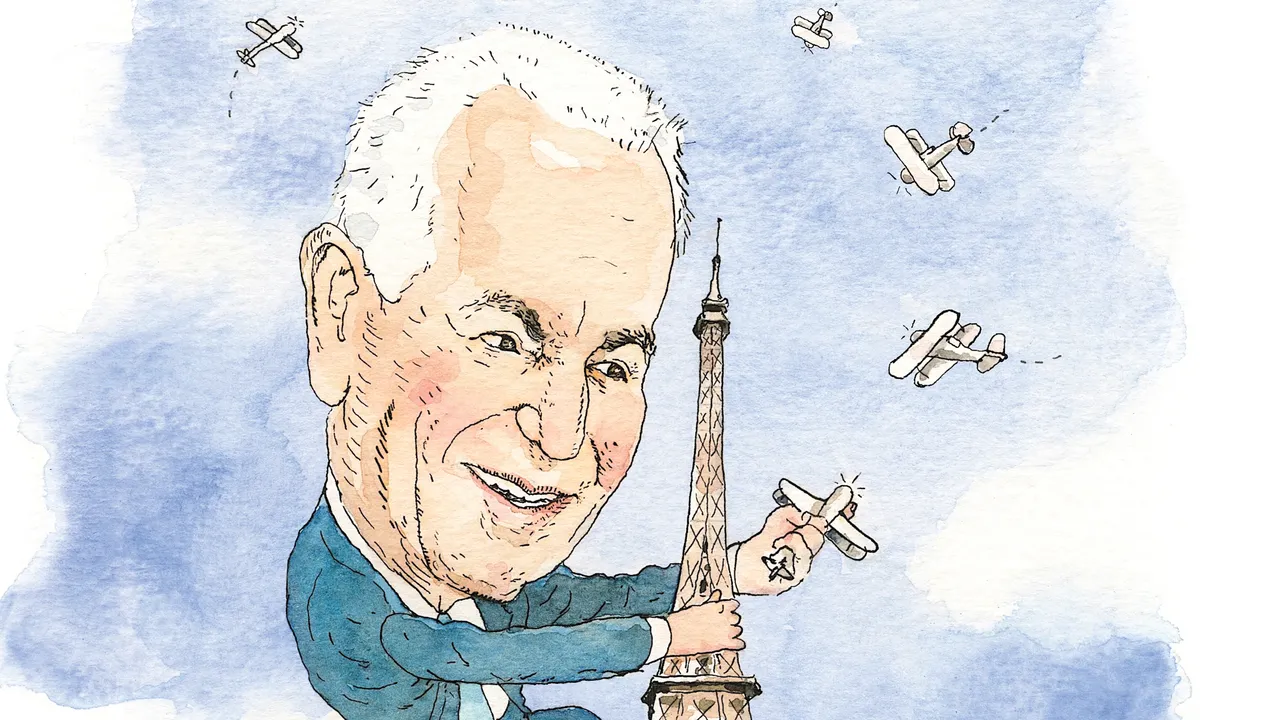
In July, to fête America on its Semiquincentennial, Charles Kushner, the United States Ambassador to France and Monaco, hosted a lavish party at his official residence, the Hôtel de Pontalba, in Paris. Louis XV-style sofas, adorned with throw pillows in stars and stripes, dotted the villa’s enormous lawn. Servers circulated in cigarette-girl fashion, carrying wicker baskets loaded with little glass bowls of dorade ceviche, as French guests in military dress perused a spread of fajitas, pronouncing the dish with a hard “j.” (Per a placard, all the food was “kosher and prepared under rabbinical supervision.”) Like his boss back in Washington, Kushner had undertaken an ambitious makeover of his temporary home, funded largely by donations from French businesspeople. He planned to add A.C., and had fixed the building’s façade, which had been held together with steel mesh to keep concrete from falling on people’s heads. “Literally, we did power washing, and we had six foot of balustrades that came off,” Kushner told me later. “This is America’s home, and it was not dignified.”
Read more The Republicans’ Remarkably Bad Midterm Campaigns
During previous Fourth of July celebrations at the Embassy, guests had mingled freely, but now a V.I.P. section had been installed toward the front of the garden, cordoned off by red velvet ropes. The imposition of such a hierarchy seemed an odd choice for an event celebrating the birth of one democracy on the soil of another—more bridge-and-tunnel than all-men-are-created-equal or liberté-égalité-fraternité. But it was in keeping with the Kushner family’s predilection for conducting public service as a private affair, and with Kushner’s role as an exemplar of MAGA-style diplomacy in Donald Trump’s second term.
Since taking up his post, in the summer of 2025, Kushner has gained a reputation for lobbing provocations onto France’s domestic scene at sensitive moments. Just six weeks after arriving in the country, he published an open letter to President Emmanuel Macron in the Wall Street Journal, accusing him of allowing France to become a bastion of antisemitism. Ambassadors are ostensibly bound by Article 41 of the 1961 Vienna Convention, which forbids them to interfere in their host country’s internal affairs. In response to the open letter, the French foreign minister, Jean-Noël Barrot, took the unusual step of issuing Kushner a summons, an official demand that he appear for a meeting. Kushner ignored the request.
About six months later, in February of 2026, a far-right activist died of a brain injury after being beaten by members of a far-left group following a street brawl in Lyon. As with the assassination of Charlie Kirk, the event prompted an onslaught of uninformed commentary and partisan distortion. French authorities urged people to avoid politicizing the incident while an investigation was under way, but Kushner’s office did not oblige. “Violent left-wing extremism is on the rise,” the American Embassy pronounced on X. In an unprecedented back-to-back censure, Barrot convoked Kushner again. When Kushner flouted that summons, too, Barrot temporarily barred him from meeting with members of the French government, citing his “apparent misunderstanding of the basic expectations of an ambassador.”
Kushner may have belatedly learned his lesson. In early October, French high-school students, protesting poor learning conditions, blocked the entrances to their schools, setting off demonstrations that have spread across Europe. Trump saw a midterm-friendly angle in the mayhem, calling the French protests the result of “Islam” and “mass migration,” but Kushner rejected his boss’s assertion. He told me, “I would not make that broad generalization.” His French bodyguards had explained that their compatriots are “professional protesters,” he said. Even after October 17th, when a day of demonstrations ended with vandals attacking government buildings and looting thousands of shops, he declined to join the Administration in pointing fingers. “I can’t stop thinking about those small-business owners who lost everything—it’s heartbreaking,” he said, adding, “Our top priority is keeping Americans safe.”
In recent decades, under both Democratic and Republican Presidents, around seventy per cent of ambassadorships have been filled by career diplomats rather than by political appointees. By contrast, only about twenty per cent of the ambassadors whom Trump has tapped since his reëlection have any professional experience in diplomacy. His hundred and twenty-two appointees have included a restaurant mogul, a Broadway-musical producer, a former N.F.L. running back, and the President’s eldest son’s ex-fiancée. The last of these, Kimberly Guilfoyle, was night-clubbing and brokering energy deals from Athens until she was forced to resign, in mid-October, in response to allegations that she’d asked a G.O.P. donor to wire a hundred thousand dollars to pay off her American Express bill. The restaurant guy, Tilman Fertitta, is posted in Rome. Over the summer, in a video shared on Instagram in which he wandered around his four-hundred-and-fifty-million-dollar superyacht with a plastic cup in hand, he announced that he would be conducting a program of “coastal diplomacy” to honor America’s birthday by touring thirteen regions “to meet and celebrate with hundreds of Italians from local communities.” In other words, he was going on a cruise. Eric Rubin, a former U.S. Ambassador to Bulgaria, told me, “Every Administration has what we call ‘clunkers,’ but we’ve never had quite this number of flagrantly unqualified people.”
Even among this cohort, Kushner, a New Jersey real-estate developer who happens to be the father of Trump’s son-in-law Jared, stands out. He does not speak French. He has never lived abroad. He served time in federal prison for illegal campaign contributions, tax evasion, and witness tampering, and was later pardoned by Trump, in 2020. The last crime, a blackmail scheme that involved hiring a prostitute to seduce his sister’s husband, suggests a dubious approach to conflict management. By Kushner’s own admission, he lacks the “natural ingredients for diplomacy,” as he told the Times. Yet Trump saw fit to hand him one of the most coveted posts in American diplomacy, the seat once held by Thomas Jefferson and by Benjamin Franklin, stewarding the relationship with America’s oldest ally. (Kushner told me that the “family issue” had “probably zero” to do with his appointment.)
That Kushner even managed to secure agrément, whereby a state accepts a foreign ambassador’s nomination, was a little miracle of American hegemony. Peter Ricketts, a former British Ambassador to France, observed, “Coming from any other country, they’d probably have said, ‘No, thanks.’ ” Many American career diplomats were taken aback. “The guy’s a former convict, and a pretty seedy and salacious one, at that,” Lew Lukens, a former U.S. Ambassador to Senegal and Guinea-Bissau, told me. “I don’t know how anyone’s not shocked by the notion that he’s the best person to represent the United States in France.”
On America’s birthday, at least, Kushner’s mood was persuasively statesmanlike. Behind the velvet ropes, he appeared at a lectern, a white-haired Jared doppelgänger in a dark suit and a red power tie, and delivered a speech paying tribute to the long-standing symbiosis between France and America and the “blood mingled” on the battlefields of Yorktown and the beaches of Normandy.
The reason for this unusually Francophile display became surmisable when Kushner welcomed his guest of honor, his friend Bernard Arnault, the head of the luxury-goods conglomerate L.V.M.H. and a major sponsor of the evening. The invitation was both a Trumpist statement—Arnault, one of the richest men in the world, embodies what Le Monde has called “the inversion of the balance of power between politics and business”—and a mark of personal admiration. Kushner, minutes earlier so composed, bobbled his words and told Arnault that he was “beyond grateful” for his attendance, as the garden filled with the unmistakable scent of a man crush.
As a treat for Arnault and his wife, Hélène, a concert pianist, the Kushners had arranged for a performance by Andrea Bocelli. The tenor emerged in an iridescent dinner jacket and blue-tinted sunglasses. The sky was darkening as Bocelli told the guests, “I think you know this song, if you want to sing along with me,” and launched into “Nessun dorma,” a Trump-rally staple.
When the show was over, I walked up to the V.I.P. area and tried to step behind one of the velvet ropes, but a man in a U.S.-military uniform rebuffed my approach. A fireworks display began, and guests filtered home while strains of Frank Sinatra’s “New York, New York” carried over the garden walls.
France became the new American nation’s ally in 1778, when Louis XVI signed the first treaty recognizing the United States’ sovereignty. Less than two decades later, the bond was tested by a scandal known as the XYZ Affair, in which France’s foreign minister, Talleyrand, demanded bribes from American envoys to Paris. More recently, the French and American governments have sparred over such issues as the Iraq War, N.S.A. spying, tariffs, the war in Ukraine, Greenland, and NATO funding. Kushner’s fraught relations, however, are notable for being a product largely of his own making. He has shown scant interest in his host country. Introducing himself to the French public in a social-media video, he said that he knew “a limited amount about France” but that he and his wife, Seryl, came often on her birthday, to “walk down the Champs-Élysées and just enjoy.” (This is kind of like saying that what you really like to do on your very regular visits to New York City is stroll around Times Square.) The sight of a packed café has been known to leave him wondering if Parisians ever go to work.
Kushner’s esteem for public servants has likewise tended to hover somewhere between condescension and outright disgust. He once vented to the trade publication The Real Deal about “stupid ethics watchdogs,” complaining, “All they want to do is assure that poor, not successful people go into government.” Kushner so far has participated little in the ceremony of the job, avoiding most receptions and ribbon cuttings. The French news channel TF1 once mistakenly referred to him as Jared. He prefers to go where he can make an impact, his advisers said, pointing to successes in bringing the N.F.L. to Paris, for its first-ever regular-season game in France; increasing French investment in the U.S.; and expanding opportunities for American businesses in France. Last spring, I was told that he hadn’t been doing many public events—it would be unseemly to be quaffing champagne in Paris as America dropped bombs on Iran. That didn’t stop Kushner from hosting a party to celebrate the release of “Melania,” the First Lady’s Amazon-backed documentary. Guests were invited to enjoy a “private screening in the presence of the film’s director, Mr. Brett Ratner,” who has been accused by multiple women of sexual misconduct. (Ratner has denied the allegations.) One attendee recalled that the Embassy seemed keen to avoid publicizing the affair: “We were specifically asked not to take any pictures or to post anything on social media.”
As a nepo hire on what Le Figaro has referred to as “the drunken ship of American diplomacy,” Kushner has often seemed less interested in winning over the French than in impressing the in-laws back in Washington. Ronald Neumann, the president of the American Academy of Diplomacy, told me, “I don’t see how he can possibly affect the opinions of the French government by regularly irritating them.” Even potential allies seem to regard Kushner warily. The former French President Nicolas Sarkozy, who has been tacking ever closer to the far right, revealed in a recent memoir that Kushner tried to visit him late last year in a Paris prison, where Sarkozy was confined for twenty days after being convicted of conspiring to fund his 2007 Presidential campaign with money from the late Libyan dictator Muammar Qaddafi. (Sarkozy is appealing.) Kushner told me that he was motivated by empathy. “I’ve been prosecuted, and my heart feels for the man,” he said. But the gesture seemed designed to cast doubt on the French judiciary’s verdict, suggesting that even a supposedly sovereign justice system was vulnerable to American meddling. Sarkozy confessed that he was “particularly surprised” by Kushner’s overture and uncertain how to handle it, wanting neither “to spark an unnecessary controversy” with his own country’s government nor to “turn away the representative of the world’s leading power while I myself was detained.”
In a new book, “Sous Influence Américaine” (“Under American Influence”), the CNN journalist Melissa Bell writes that the U.S. today is behaving like Russia, seeking to “destabilize, fragment, and vassalize Europe,” but that American interference can be even more insidious, “because it comes from a ‘friendly’ country.” Nathalie Loiseau, the chair of an ad-hoc European Parliament committee that aims to combat foreign interference, noted, as examples, the Trump Administration’s decisions to sanction the French bureaucrat Thierry Breton for his role in regulating American tech companies and to freeze the assets of Nicolas Guillou, a French judge on the International Criminal Court panel that issued arrest warrants for Israeli leaders. Magali Lafourcade, a French magistrate and the secretary-general of the National Commission on Human Rights, told me, “The idea is to say, ‘You’re under scrutiny, and you’re all at risk the moment you touch American interests.’ ”
Kushner is Trump’s man in Paris, but he is also a filial franchisee. One recent visitor to the Hôtel de Pontalba stumbled upon a supply closet filled with copies of “Breaking History,” Jared Kushner’s 2022 memoir, neatly labelled “Signed.” Last fall, the Embassy’s Instagram page posted a video of Charles pacing the ornate rug of a wood-panelled office with a phone to his ear. “POV: your son calls mid-meeting to tell you that he did it!” the caption read, touting Jared’s role in brokering a Gaza peace agreement. In “Breaking History,” Jared writes, of Arab leaders, “As the son-in-law of the president, and a former executive of a family business, I represented something that they found familiar and reassuring. They knew that when I spoke, I did so as an extension of the president in a way that few administration officials could.” Charles is an extension of the extension, burnishing the Kushner brand in the heart of Europe.
The Kushners’ longtime habit of mixing family and business has found new applications since they’ve entered the political realm. In 2018, when their real-estate firm, Kushner Companies, was in desperate need of a bailout for its over-leveraged purchase of a tower on Fifth Avenue, Jared traversed the globe, hobnobbing with world leaders as a senior White House adviser. At the last minute, an investment fund controlled by the Qatari government swooped in with the billion dollars that the Kushners needed. (The Kushners claimed that they hadn’t broken any ethics rules, because Jared had divested from the building, and that the deal had nothing to do with Trump’s subsequent efforts to negotiate an end to Gulf nations’ anti-Qatari blockade.) More recently, Jared’s private-equity firm, Affinity Partners, has raised billions of dollars from Middle Eastern governments as Jared serves as a U.S. envoy in the region.
The Kushner family business stretches back three generations, to Charles’s father, Joseph. He and Charles’s mother, Rae, were Polish Holocaust survivors who spoke often about the traumas they had endured. “There was seldom a family gathering or holiday meal in which it was not mentioned,” Jacob Schulder, one of their grandchildren, writes in a family history, published in 2024. Joseph had spent most of the war hiding in the forest with the Bielski partisan force, a Jewish resistance group. Rae, trapped in a ghetto in Novogrudok, watched the Nazis murder her mother and one of her sisters. She was forced to scour blood from the paving stones of the town square after a mass killing, accompanied by an orchestra. Eventually, after villagers dug an escape tunnel, she fled to the forest with the remainder of her nuclear family. Her brother, Chanan, became separated from the others and was never found.
Joseph and Rae spent several years in an Italian displaced-persons camp before immigrating to the United States. Kushner was Rae’s family name. As Andrea Bernstein writes in “American Oligarchs,” Joseph adopted it as his own and passed himself off as Rae’s father’s son, to more easily obtain a visa. After a few years in New York City, the couple settled in Elizabeth, New Jersey, where Charles, the third of their four children, was born, in 1954. He was named in honor of Chanan. Despite the family’s measure of suburban stability, money was tight. Joseph was transitioning out of the carpentry trade into real estate, and he and a partner were planning to build spec houses on three lots that they’d bought in Rahway. Jacob Schulder recounts that Joseph, cash-strapped from the purchase, “borrowed a hundred dollars from his uncle, Moshe, to make Charlie’s bris.” According to New York, when a young Charles came home from school one day with a guitar, Joseph broke it over his knee, saying, “A boy has to learn how to make a living, not play a fiddle.”
Joseph ultimately acquired some four thousand rental apartments in New Jersey. After his death, in 1985, Charles prevailed in a succession battle with his older brother, Murray. Armed with a law degree and an M.B.A., he transformed his father’s parochial holdings into Kushner Companies, amassing properties and investments. As his fortune grew, he took on a seigneurial role in the community, endowing yeshivas, underwriting World Series outings for sick children, and handing out prodigious political contributions, mostly to Democratic candidates. Masters of social capital, he and Seryl were ubiquitous at weddings and on the funeral circuit (they’d show up for the services, not just for the shivas) and were renowned for, as a family friend recalled, “taking care of their friends” while never forgetting a grudge. As major donors to pro-Israel causes, they got to know Benjamin Netanyahu, who once spent the night at their house, borrowing Jared’s bedroom.
Murray worked for the company, as did Charles’s two brothers-in-law (his sister’s husband and his wife’s brother). But in 2000, during a Passover Seder at the Fontainebleau hotel in Miami Beach, Charles and Murray clashed over a plan to buy another firm for more than a billion dollars; the deal had collapsed when Murray refused to sign off on it. The next year, again at the Fontainebleau, Charles lashed out at his sister, Esther, and her husband, Billy Schulder, whom he suspected of sympathizing with Murray. “You’re a fucking putz!” he screamed at Billy, according to New York, cementing one of the most consequential family feuds of the twenty-first century.
Kushner’s complicated web of interests had begun to attract the attention of federal authorities. In 2003, he learned that a grand jury was investigating him on charges of tax evasion and campaign-finance fraud—and that Esther and Billy were coöperating with investigators. Kushner, in a fury, devised the salacious revenge plot that has colored his reputation ever since. With the help of a moonlighting East Orange police captain and his private-eye brother, he recruited a sex worker to set a honey trap for Billy. The tryst was consummated at a motel called the Red Bull Motor Inn, where Kushner’s accomplices had installed a video camera inside a digital alarm clock.
The former New Jersey governor Chris Christie, who prosecuted Kushner’s case during his years as a U.S. Attorney, has called him “the most disgusting defendant” he encountered in his career. In Christie’s memoir, he describes how Kushner screened footage of Billy’s rendezvous in a conference room at his corporate offices, letting out “raucous guffaws.” Kushner wanted to show the tape to Schulder’s children—Kushner’s own niece and nephew—but ultimately settled for mailing a copy to the Schulders, timing the delivery so that his sister would receive it just before her son’s engagement party. In August, 2004, Kushner pleaded guilty to eighteen counts of tax fraud, witness intimidation, and F.E.C. violations. Six months later, he was sentenced to twenty-four months in prison. His reputation in shreds, he reported to a federal prison camp in Alabama.
Charles apologized for his actions, writing in a letter to his sister that he had “let hatred invade his heart” and had “committed a terrible sin,” but Jared never stopped believing that his father was a victim. His book, putatively “a White House memoir,” opens with Charles’s arrest, which Jared calls “an astonishing betrayal” on the part of his relatives. For years, he writes, he was traumatized by the smell of popcorn and Pop-Tarts, which were available in the vending machine of the prison’s waiting room. In February of 2006, after serving eight months, Kushner secured a transfer to a halfway house by claiming that he was an alcoholic.
That July, just weeks before Kushner’s return home, Jared paid ten million dollars to buy the New York Observer. One of Charles’s business associates told a reporter that the paper was a “graduation present” for Jared, but the purchase was very much a joint venture, guaranteeing entrée, for father and son, into a Manhattan world of very important people who didn’t much care about whatever the Kushners had got into across the river. “Charlie was a New Jersey criminal, so he needed a social reset,” the family friend recalled. A few years later, Jared married Ivanka Trump, at Trump National Golf Club, in front of five hundred guests, including Rupert Murdoch and Russell Crowe. The Kushners had arrived.
After Trump’s election in 2016, Jared and Chris Christie found themselves together on the Presidential transition team. Then Christie was abruptly fired, a move that he accused Jared of engineering as payback. Christie recently told me about an encounter with Charles, in the spring of 2023, at Fresco by Scotto, a clubby Tuscan restaurant near Rockefeller Center. Christie was there having lunch with the former New York governor Andrew Cuomo. “All the sudden, I see Cuomo’s eyes get bigger,” Christie recalled. “I felt someone pat me on the shoulder.” He turned around in his seat to find Charles Kushner standing behind him. According to Christie, despite the fact that he had sent Kushner to prison, the two men had never spoken.
“Governor, I think it’s long overdue that we meet,” Kushner said to Christie. “My son has suggested that we get together for dinner.”
Read more The Political Upstarts That May Decide Israel’s Election
Christie interpreted Charles’s approach as a typically Kushnerian power play. “He and his son are carbon copies, and they have this very passive-aggressive style about them,” he said. “That was him hoping I’d be uncomfortable.” At the end of the encounter, Kushner held out a hand. “You can call me Charlie,” he said. (Through a spokesperson at the U.S. Embassy in Paris, Kushner characterized Christie’s account as “inaccurate.”) If nothing else, the incident demonstrated Kushner’s extraordinary capacity for the long game, for grinning and bearing anything that might eventually allow him to best an adversary. No get-together was ever arranged, but Christie told me that more recently, after he’d sat down at Ristorante MV, an Italian spot in Bernardsville, New Jersey, a server brought a bottle of expensive red wine to his table. “I told him, ‘I didn’t order any wine,’ ” Christie recalled. “He said, ‘Oh, no, sir, the wine was sent to you by your friend—Mr. Jared Kushner.’ ”
For both Republican and Democratic Administrations, the plush, well-staffed U.S. embassies of the major European capitals have traditionally served as parking grounds for big political donors who excel at schmoozing, if not at statecraft. Trump’s first Ambassador to France, Jamie McCourt, a G.O.P. fundraiser and a former co-owner of the L.A. Dodgers, took a look at the Hôtel de Pontalba’s lush garden, which abuts the Élysée Palace, in the heart of one of the city’s most historic districts, and, as aides recalled, asked if she could put in a pool. Kushner’s appointment to the Paris post was the most controversial since 1993, when Bill Clinton selected Pamela Harriman, a thrice-married Washington power broker who was ridiculed as a promiscuous gold-digger. During her confirmation hearing, Senator Strom Thurmond proclaimed, “They’re sending the Whore of Babylon to Paris!”
In the lead-up to Kushner’s arrival last summer, speculation about his agenda swirled in Paris. The French didn’t know what to expect. In one sense, the appointment was an insult. Géraud Araud, a French Ambassador to the United States during Barack Obama’s Presidency, wrote on X that Kushner, “needless to say, doesn’t have the slightest knowledge about our country,” and counselled followers to read Kushner’s résumé: “ ‘Juicy,’ as the Americans would say.” At the same time, Kushner’s proximity to Trump presented an opportunity. “It’s always better to have the ear of the President, no matter the Ambassador’s competence,” Célia Belin, the head of the Paris office of the European Council on Foreign Relations, told me. “The French actually love to deal with those kinds of Republicans, because their interests are laid out more simply, and they may actually be aligned on things like strategic autonomy.”
Kushner got to Paris on July 10th. The same day, he visited the Mémorial de la Shoah, noting afterward the “profoundly personal” nature of this “first step of my stay in France.” Just weeks later, he shared his impressions of the place in his open letter to Macron in the Wall Street Journal: “I write out of deep concern over the dramatic rise of antisemitism in France and the lack of sufficient action by your government to confront it.” Macron had announced his intention to recognize Palestinian statehood at the upcoming U.N. General Assembly, and Kushner wrote that Macron’s public statements on the subject had served to “embolden extremists, fuel violence, and endanger Jewish life in France.” His language closely echoed that of a letter Netanyahu had issued to Macron a week earlier. Kushner offered twinned reminders, one political and one personal. “Anti-Zionism is antisemitism—plain and simple,” he wrote, adding, “President Trump and I have Jewish children and share Jewish grandchildren. I know how he feels about antisemitism.”
The letter called out the very real problem of resurgent antisemitism in France. Since October 7th, antisemitic acts have soared, from fewer than five hundred incidents in 2022 to more than fifteen hundred in 2023 and again in 2024, with thirteen hundred and twenty acts reported last year. “There has truly been an explosion,” the historian Marc Knobel told me. According to one study, nearly a quarter of French people under the age of thirty-five consider it “acceptable” or “understandable” to vandalize a Jewish business or a synagogue in order to express opposition to Israeli policy. Kushner told me that he’d experienced antisemitism in France directly, when one of his grandsons was visiting and wore a yarmulke out for a walk during Passover. Kushner recalled, “We put one step out the door here—people yelling, ‘Fuck the Jew! Fuck the Jew!’ ”
David Amar, the president of the Consistoire de Paris/Île-de-France, an organization that oversees Jewish worship in the capital region, defended Kushner’s letter, telling me, “He simply said what everyone thinks aloud.” But, to many other leaders in France’s Jewish communities, Kushner’s claim that the French government had failed to act did not reflect reality. Responding on X to Netanyahu’s letter, Yonathan Arfi, the president of the Representative Council of Jewish Institutions in France, had praised “the regular dialogue established with public authorities against antisemitism over the past twenty years,” pointing to, for example, the government’s commitment to safeguarding Jewish places of worship. The lawyer Patrick Klugman, a longtime advocate for Jewish causes, told me, of Kushner’s intervention, “Theoretically, I should have been very pleased, but I was not, because it wasn’t serious, it wasn’t balanced, and it gave a false picture. Just because you’re not happy with what France is doing in the Middle East, you can’t say that the country is permissive to antisemitism.”
Kushner’s stunt, Klugman added, had put French Jews in an impossible position, awakening noxious stereotypes that reached back to the Dreyfus Affair. “It makes the Jewish population in France look as if they were not French but under American jurisdiction or protection, and this is totally counterproductive,” Klugman told me. If Kushner’s goal was to fight antisemitism in France, immediately alienating the country’s leadership and a significant portion of French Jews didn’t seem like a particularly efficient way to go about it. Nathalie Loiseau, the European lawmaker, said, “Sometimes you have to do undiplomatic things to have an effect, but the effect he had was most people teaming up against him and telling him to mind his own business.” (Kushner told me, “I think what I did was a net-net very positive, because nobody has the courage to say what I say, to express what I express.”)
The summons from Jean-Noël Barrot requested that Kushner appear at Quai d’Orsay, the seat of the French Foreign Ministry, the next day. These choreographies can be stagy, but most diplomats take them seriously, cognizant of the fact that they’ll need solid relationships in the event of a crisis, like, say, a terrorist attack. John Emerson, a former U.S. Ambassador to Germany who received his own summons after it emerged that Chancellor Angela Merkel’s phone had been tapped by the C.I.A., told me, “When you’re dealing with an ally, you go in and play your role. You respect their protocols. Otherwise, that disrespect becomes the story, instead of the message you want to deliver.” When Kushner didn’t show, Paris Match ran a piece headlined “The American Ambassador Prefers to Continue His Vacation,” with an accompanying photograph of Kushner on the French Riviera in a jaunty straw hat. He told me, of his decision to blow off the meeting, “I’m seventy-two years old. I’m not getting called to the principal at this stage in my life.”
The whole affair seems to have had little effect on Kushner’s sense of tact. Last October, he attended a dîner mondain—a networking dinner for people far too well placed to attend networking dinners—with luminaries from French business, culture, and journalism. It was hosted by James Lieber, a prominent consultant, at his apartment in Paris. The goal was to add social lubrication to the creaky wheels of diplomacy, but, according to several attendees, the conversation took a contentious turn. One guest told me, “Kushner started the dinner by saying that France was the main antisemite country of Europe, with Macron as the Antisemite-in-Chief.” (Lieber and the Embassy spokesperson denied that Kushner made these comments.) Eventually, the philosopher Bernard-Henri Lévy spoke up with an opinion that, per Le Monde, left Kushner in a “fury.” Lévy’s latest book, “Israel Alone,” argues that the October 7th attack prompted “a worldwide eruption of anti-Semitism, cloaked in anti-Zionism,” but, even for him, Kushner’s accusations went too far. According to the guest, “Lévy said, ‘Quand même, the letter you sent to the Wall Street Journal was quite tough.’ ” Kushner’s mood darkened as he replied, “No, it was actually very mild.” Lieber said that “the frank differences of opinion” were “only a brief part of an otherwise pleasant and interesting evening.”
Trump’s decimation of the federal bureaucracy, which included cutting thousands of jobs at the State Department, has triggered an unprecedented exodus from the Foreign Service. As of 2025, an estimated one-fourth of active officers had left the government altogether. Counting Guilfoyle’s vacated seat, ninety-three ambassadorial posts are currently unfilled, including in critical countries such as Germany and the United Arab Emirates. “It’s a big up-yours to the rest of the world,” Rubin, the former U.S. Ambassador to Bulgaria, told me of the vacancies. “And it’s a huge gift to countries like China, which never fails to fill their embassies overseas.”
Within the diminished ranks, Kushner is hardly the only Ambassador to run afoul of his host country. Not long before Guilfoyle’s resignation, the Wall Street Journal reported that she’d warned the Greek energy minister that the U.S. could topple governments in “any country we want.” In Canada, more than a quarter of a million citizens have signed a petition to remove Ambassador Pete Hoekstra, for, among other things, having “normalized the Trump administration’s threats to annex Canada as the ‘51st state.’ ” In Brussels, the Ambassador to Belgium, Bill White, was summoned by the government after publicly claiming that an Antwerp prosecutor’s investigation into ritual circumcisions by Jewish mohels without medical training was antisemitic. During an America 250 celebration that White hosted, police aggressively ejected a reporter and his editor after the reporter tried to ask White a question.
This new class of flamethrowing amateur diplomats has little reason to pursue the humdrum work of nurturing ties. Peter Ricketts, the former British Ambassador to France, told me, “I think the motivation of all these people is to get a good word from the boss. They don’t really care a fig how it’s received in the country they’ve been sent to.” Their provocations often feel like crude extensions of the American culture wars, as when the Ambassador to the Dominican Republic recently had a painting by Kehinde Wiley removed from the U.S. Embassy there, complaining that it depicted a “picnic” with “some lesbians.” The Ambassador’s partner in that endeavor was Erin Scavino, a former “Apprentice” star who now runs the State Department’s Art in Embassies program. According to Puck, Scavino, acting as a sort of MAGA art enforcer, has also targeted works such as a psychedelic glass sculpture featuring a horned figure and an infant’s impassive face, which was removed from the U.S. Ambassador’s residence in Bucharest after a G.O.P. congresswoman deemed it “satanic baby art.”
Such tactics dovetail with the Administration’s wider political objectives abroad, from establishing white victimhood to bolstering Israel and fighting the perceived weakening of Judeo-Christian values. Last year, at the Munich Security Conference, Vice-President J. D. Vance shocked Europeans by warning that the biggest danger to the Continent was not Russia or China but “the threat from within.” Soon after, Samuel Samson, a twenty-seven-year-old Deputy Assistant Secretary of State, expanded on the Vance doctrine in a manifesto, published on the State Department’s Substack account, titled “The Need for Civilizational Allies in Europe.” Across Europe, he wrote, “a decadent governing class afraid of its own people” was waging “an aggressive campaign against Western civilization itself.” Further evidence of the Administration’s attitude toward the Continent surfaced in a private Signal chat that had been formed just before the U.S. launched strikes against the Houthis in Yemen. Vance wrote, “I just hate bailing Europe out again.” Defense Secretary Pete Hegseth found time to chime in: “VP: I fully share your loathing of European free-loading. It’s PATHETIC.” In the Trumpian mind, Europe is to the world as Manhattan is to America—an irksomely glamorous den of effeteness and decay.
Compared with Vance’s and Hegseth’s grudges, though, Kushner’s concerns about the Continent run deep. Less than a century ago, the Kushners were Europeans, too. Over the summer, he reportedly urged Trump to extend refugee status to French Jews, even as the White House was stripping Temporary Protected Status from hundreds of thousands of Haitian immigrants who’d fled catastrophe in their home country. The guest at the dîner mondain recalled Kushner remarking, with tears in his eyes, “The reason I’m here talking to you tonight is that my parents got wise enough to move to the United States.”
Among U.S. Ambassadors to France, domestic pot-stirring is not unprecedented. Charles Rivkin, an Obama appointee, wrote, in a leaked classified cable from 2010, that he intended to hammer France on the theme of “minority rights” and to challenge officials on “sacred cows” of French thought, such as the idea that universalism transcends ethnic and racial identities. What is different now is the scale, the stamina, and the straightforward ruthlessness of American obtrusions, and a sense that, as the transatlantic alliance deteriorates, the Trump Administration has made France a laboratory of interference.
Last year, for instance, soon after Kushner’s confirmation, Pierre Haski, the president of Reporters Without Borders, received an unusual visit, orchestrated by the American Embassy, from two State Department representatives. One of them, it turned out, was Samuel Samson, the author of the “Civilizational Allies” manifesto. The pair handed Haski business cards, emblazoned with golden eagles, and then started interrogating him about press freedom. The men cited, as the basis for their concern, the treatment of the far-right leader Marine Le Pen, who earlier that year had been found guilty of embezzling millions of euros in E.U. public funds to finance her political party, Rassemblement National (R.N.). According to Le Monde, the pair characterized her conviction as an authoritarian crackdown, and compared France to North Korea. Haski told me, “It was one of the most bizarre encounters I’ve ever had.”
France is the European Union’s only nuclear power and its only permanent member of the U.N. Security Council. It is also home to the Continent’s largest Jewish and Muslim populations. Magali Lafourcade, the magistrate who heads the National Commission on Human Rights, told me that this makes France “the best country to attack in order to attack Europe.” Lafourcade had had her own off-putting encounter with the same duo who visited Haski. Again, the men’s questions focussed obsessively on Le Pen and her legal troubles. “They were very courteous and at the same time very intimidating,” Lafourcade recalled. The meeting left her alarmed enough that she reported it to the Ministry of Foreign Affairs. She said, “I even went out to smoke a cigarette, and I don’t smoke—I felt so uneasy.” The incident preceded Kushner’s arrival in Paris, but it struck Lafourcade as a fitting prelude to his controversial public statements. The Administration’s tactics have reminded her of recent malicious acts in France tied to Russian operatives, such as the defacing of a Holocaust memorial with bloody handprints and the planting of a pig’s head outside a mosque. “It’s all to increase division and polarization,” she observed. (After Lafourcade discussed her encounter on television, her X account was suspended. She told me, “I perceive this as retaliation and a restriction of my freedom of expression.”)
The Presidential election, next May, will be of great consequence for France. After a decade in power, Macron cannot run again. His tenure has left a vacuum in the center, with a profoundly disillusioned French public gravitating toward extremes. Le Pen has been polling far ahead of any other candidate, and the recent unrest stands to strengthen her appeal among law-and-order voters seeking a vehement response. Amy Greene, a senior fellow at the think tank Institut Montaigne, told me that Trumpist actors view France as a “hopeful horizon” for a wider right-wing movement. “If such an economically powerful, nuclear power swings to the far right, then this is really a precursor for what the rest of Europe could look like,” she said.
In October, I returned to the Hôtel de Pontalba and met Kushner in the Samuel Bernard Room, a gilded salon named for one of Louis XIV’s bankers. After small talk about his properties in New Jersey, Kushner installed himself on a fauteuil upholstered in gold brocade. Seryl sat nearby, on a matching couch, facing three advisers. “I can’t sit on those sofas anymore at my age,” Kushner said. The air was suffused with the scent of freshly baked chocolate-chip cookies, which an aide proffered on a silver plate.
Several months into Kushner’s appointment, he had invited Le Pen and Jordan Bardella, the R.N.’s mediagenic young president, to the Hôtel de Pontalba. He then posted a photo of the three of them on X, writing that he “appreciated the chance to learn” from Le Pen and Bardella “about the RN’s economic and social agenda and their views on what lies ahead for France.” Trump has publicly backed the R.N., but for Kushner, a public servant singularly invested in combatting antisemitism, the French far right is an awkward ally. Marine’s father, Jean-Marie Le Pen, the founder of the movement, famously believed that the Nazi gas chambers were a mere “detail” of history. In recent years, the R.N. has remade itself as a champion of Israel, but I wondered whether the Party’s history bothered Kushner.
He told me, “I asked Marine Le Pen very directly, ‘Your father was a Holocaust denier. You have become, a generation later, a supporter of Israel. How did that light switch turn on and off so quick?’ She said it was a long time ago, and that she’d distanced herself from her father and his generation.” Kushner added, “I accepted that.”
In September, the French investigative outlet Mediapart unearthed antisemitic messages that Bardella had allegedly sent as a young R.N. adherent in the twenty-tens, including statements like “All the banks are owned by Jews.” (Bardella has denied sending the messages.) Kushner has met with representatives from center-left parties, but he told me that he has pointedly shunned Jean-Luc Mélenchon’s far-left party, La France Insoumise, over concerns about antisemitism in its leadership and its ranks. “I made it clear that blatant antisemites supported by the Muslim Brotherhood are not welcome in this residence, and whoever likes it, and whoever doesn’t, I don’t care,” Kushner said. But, when I brought up Bardella’s slurs, Kushner seemed untroubled.
“I know that he’s been to Israel, that he’s been very well received in Israel, and that he’s been very outspoken about being in favor of Israel,” he said.
“Would you receive him again here?” I asked.
“Yes,” he replied.
During our conversation, Kushner wavered between tough-guy talk and surprising delicacy. His views on Europe didn’t always align with the narrative of decline that his MAGA colleagues are pushing so vigorously. He told me that he had not witnessed much evidence of the “threat from within,” noting, “I don’t necessarily see it the way J. D. Vance sees it.” But he did share with his colleagues in Washington a capacious sense of the privileges of public office. After Sarkozy was released from prison, last November, Kushner finally met him, for lunch. As a further show of support, Kushner invited Sarkozy and his wife, Carla Bruni-Sarkozy, to his Fourth of July bash, and gave them a place of honor next to him and Seryl, with the Arnaults on the other side. Kushner told me that it was a “terrible slap in the face to France” to jail a President, “no matter what you did or didn’t do.”
“So is your idea that people in positions of power should not be put in prison or prosecuted?” I asked.
“I think if he shot somebody in the street, I’d feel different than if he had some nebulous dealing with some government,” he replied. Then he added, sounding miffed, “Ask me a fair question.”
An aide cut in to say that our time was up.
Kushner quickly recovered his bonhomie and said how proud he was “to represent our country.” Seryl began wrapping the untouched cookies up for me in napkins embossed with the ambassadorial seal. “I just got the coasters made,” she said. On my way out, the Kushners stopped by a side table, stacked with documents and tomes. “Do you have our son’s book?” Charles asked, handing me a copy of “Breaking History.” They insisted that I leave with more family mementos: a magazine with the face of their younger son, Josh, on the cover; a copy of a new children’s book co-written by Josh’s wife, Karlie Kloss, titled “Spaghetti Code: A Story About Problem-Solving, Pasta, and the Power of Big Ideas.” Speaking of their closeness to their kids and grandkids, all of whom live in the U.S., Kushner had told me, “It was a big sacrifice for us to come here.” He added, “We go back whenever we can.” ♦
Read more The State Officials Defending the Midterms from the President