 By admin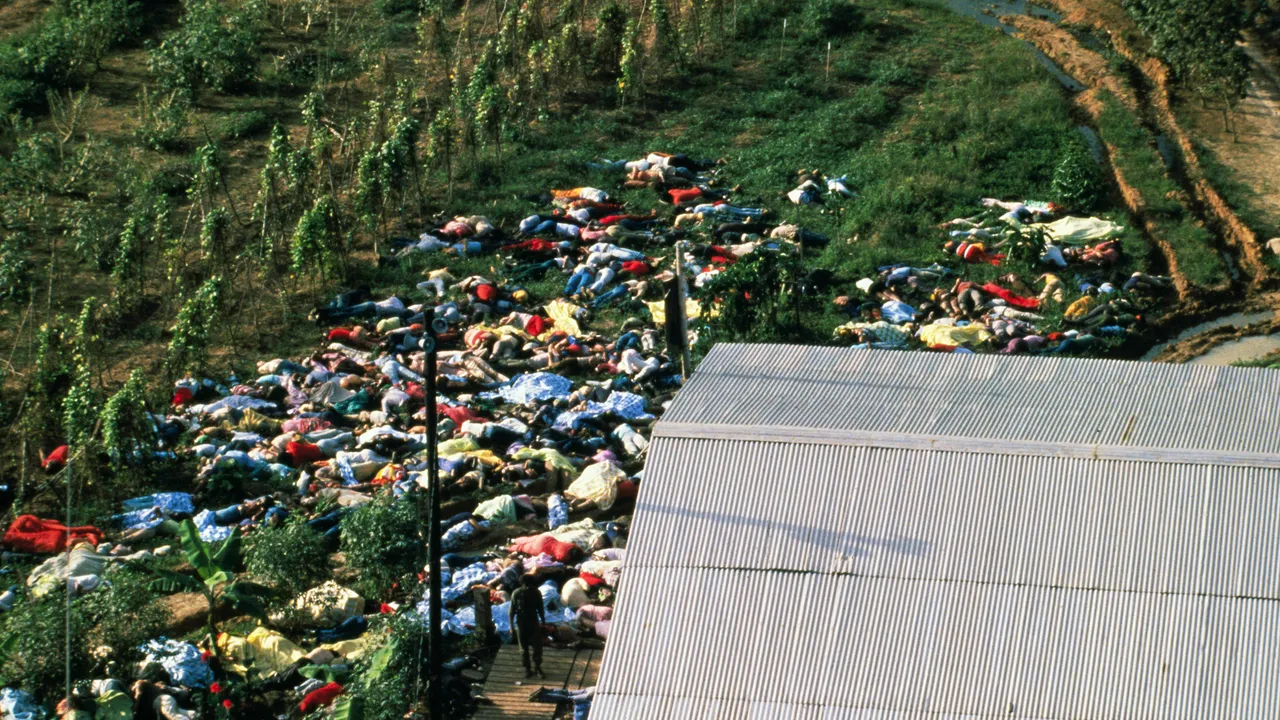
On November 18, 1978, more than nine hundred members of the Peoples Temple died at Jonestown, the agricultural settlement they had founded in a remote part of northern Guyana. Many, in answering the call to “revolutionary suicide,” drank Fla-Vor-Aid laced with cyanide; others who resisted were forcibly dosed. But nearly all of the congregants had ended up here, thousands of miles from home, because of Jim Jones. Fiery and charismatic, Jones established what would become the Peoples Temple in Indianapolis in the mid-nineteen-fifties, preaching a belief system that combined Christian millenarianism with visions of socialist uplift. He was particularly popular among African Americans, using the pulpit to argue for integration and social justice. Like many outsiders of mid-century America, eventually the Temple headed West; Jones and his followers would eventually find a home in San Francisco. For a while, they were known for their commitment to community work and to racial equality, and also for a willingness to show up at protests and support comrades in need.
Read more England’s Dynamic, Divergent, Deadly Duo
The founding of the Jonestown settlement in Guyana, in the mid-seventies, served two purposes. Jones’s erratic, autocratic leadership had begun attracting negative publicity in the United States; he wanted to relocate the church somewhere free from prying eyes. His believers hoped to start something radical and new, and, for a time, they felt they had succeeded; stories circulated of Jonestown as an agrarian, communal paradise. But the day-to-day reality of life under Jones’s violent, coercive rule was far bleaker, prompting relatives of Temple members to demand an investigation. On that horrific day in November, the congressman Leo Ryan was wrapping up an uneventful fact-finding visit to Jonestown, during which several people had requested to return to the U.S. He agreed to take the defectors with him on his return flight. As they waited to leave at a nearby airstrip, they were ambushed by gunmen, sent by Jones, who killed Ryan, three journalists, and a defector from the Temple, and wounded others. Jones then commanded his worshippers to take their own lives. More than nine hundred people died that day. Almost immediately, the massacre became a deeply symbolic event.
Discover notable new fiction, nonfiction, and poetry.

Many writers travelled to Jonestown to survey the shambles and determine whether this was a utopian experiment gone astray or a madman’s fever dream destined to fail. Shiva Naipaul was among them. He was thirty-three, the author of two well-regarded novels, and a journalist interested in questions of belonging. Naipaul was not a believer by nature. “Anything was possible,” he remarked about the social movements of the late sixties and the seventies—and he did not mean this as an endorsement.
Going to Jonestown felt like a homecoming of sorts. Naipaul grew up in Trinidad, a descendant of Indian indentured laborers who were recruited in the late eighteen-hundreds. He and his brother, V.S., didn’t fit neatly within British hierarchy, which still defined the class structure (and ambitions) of the colonies in the Caribbean. But their alienation did not radicalize them the way it would others, and they retained a belief in the privilege and status conferred by, say, an Oxford education. It’s often said that V. S. Naipaul’s condescending depiction of Black characters was a by-product of this pedigree. Both men were interested in questions of freedom and the perspective from the periphery, but they didn’t share the era’s desire for liberation.
As he set off for Guyana, just two weeks after the events of Jonestown, Shiva Naipaul reflected on the political climate of the Caribbean. He had left Trinidad for Oxford in 1964. Fourteen years later, he saw it as a place where “society was in disarray and men seemed to be decaying.” Where others celebrated the sixties and seventies as an era of toppling old orders, Naipaul was suspicious of how “the language of religion could be transformed into the language of politics.” In his native Trinidad, the Prime Minister, Dr. Eric Williams, had swept into office as a kind of Black Power savior-statesman, while the people of neighboring Grenada had elevated a “mystical maniac” in Eric Gairy. Third Worldism had become the ruling logic of the dispossessed, and Naipaul was skeptical that this “state of mind,” which represented an awakening of the global underclass, was a healthy one. He believed that the disenfranchised had no interest in solutions to political problems but, rather, that they wanted to feel as though they were being saved. And this desire for a messiah created the conditions for exploitation: “Those who ought to know better nourish our crazy dreams of resurrection and redemption; those safely beyond the borders of our madness underwrite our lunacies.”
Naipaul may have been skeptical by nature, but he was also a brilliant and curious chronicler of travel. Where did you come from? Where are you going? There’s an attentiveness to fellow-travellers who misread him, and a desire to understand what other people are looking for. Mere paragraphs into “Journey to Nowhere: A New World Tragedy,” his book about Jonestown, which has been newly reissued by Outsider Editions, he describes a Guyanese passenger on his flight who confesses to a bit of callous relief: now he won’t have to explain where he’s from. Elsewhere, it’s someone whose gaze lingers too long on his brown skin, or the government handler assigned to corral visiting journalists who seems unnervingly enthusiastic. Naipaul recalls the air of competition as writers fought for the grisliest material. “There’s hardly a single person around this pool who isn’t writing a book. But mine’s going to be different,” one American writer boasts. The more haunting the story, the better.
Published in the United Kingdom in 1980 as “Black & White,” and in the United States the following year as “Journey to Nowhere,” Naipaul’s book was, indeed, different. Like many others, Naipaul offered a disillusioned view of the era; he was given to fatalism about utopian hope. But he was far less interested in the trope of the charismatic cult leader than in the mechanisms of belief. He explores the lives of Jones’s disciples and takes seriously their ideals, the way they summoned “tears as a weapon.” He laments the loss of self to someone else’s vision. “Messy human frailties were lifted up to an exalted sphere. The war between messianic lust and apostasy became a war between the forces of Good and Evil.” Yet the sides are never as clean as “good” and “evil,” just as Jonestown was neither a “paradise” nor “Hell on earth.”
Where did the promise go wrong? In Jonestown, where the feeling of destruction was detectable in the atmosphere, Naipaul realized that he needed to go to California to comprehend what had happened. “Iowa,” he writes, “does not, as a rule, attract the vagrant and the restless. Its neat farms and lush meadows discourage fantasy.” Naipaul remained fascinated with what kinds of visions drew the dispossessed toward messiah-like figures. What dangers lived inside these exuberances? And, so: the self-proclaimed Golden State. “California sucks in America’s loose ends,” Naipaul writes. “It twists and tangles them in a hundred different ways.” This isn’t the unnerving California that lies between the lines. It’s the California that advertises itself in billboard-large letters as a kind of lab-perfected hyper-Americanism, an optimism, an ecstatic idealism.
“Journey to Nowhere” has some of the most penetrative and acerbic writing about California that I’ve ever read. I haven’t lived there for more than half of my life, yet having been raised a Californian remains an integral part of my identity. I used to look out the window whenever I flew into San Francisco and believe the sky was golden. Our family hadn’t ended up there by design, but we slotted ourselves into the West Coast’s intoxicating myths—the point at which the frontier, expansion, all the harshness of history was tempered by the chill Pacific. Part of this fantasy is about reinvention—we were not a state built on cotton or steel, commodities that felt distant and remote. Rather: bluejeans, internet browsers, gold. Instead of being under the yoke of history, we were freethinking and new.
Read more How to Write When You’re Feeling Stuck
They often call it the twenty-first century. California, in this view of things, is something more than merely the richest and most populous state of the Union, the first among equals. It is a state of mind; a state of being. The dogma has it that what California is doing today, the rest of the United States will be doing tomorrow; and, of course, whatever the United States is doing tomorrow, the whole world will be doing the day after. According to one of its devotees, it is a seminal ground for new ideas, one vast laboratory of the human spirit. Californians are the ultimate pioneers, a chosen people living in a golden land flowing with milk and honey, whose precocious self-consciousness makes them more than ordinarily human.
Naipaul’s allergy to youthful idealism can be off-putting. He was constantly sizing up a situation, measuring reality against ideals, dissecting the activist’s sloganeering notions of identity and progress. He moves through scenes with a profound detachment, but he’s not dismissive. He wants to hear what people want to tell him, if only to stress-test his own beliefs. The vigorous extremes of life interest him and energize his sentences. I only ever knew Jonestown as a story, and Naipaul’s telling was different from the ones I had grown up reading, which focussed largely on the perils of cult charisma rather than on those of a freethinking culture writ large. As a young person in the Bay Area, I saw remnants of that past everywhere: in the names of parks and streets, in the legacies of service and organizing, and, maybe, in the way that revolutionary ambition, heard ungenerously, can sound like lunacy.
“Journey to Nowhere” was a controversial book upon publication, largely because it presented such a slanted telling. For all of Naipaul’s interest in individuals, it is a book that traffics in grand abstractions. Yet maybe his version of Jonestown’s California roots holds special appeal now, decades later. His writing interrogates not just good and evil but reverberations through time: the bruising force of personality, a politics scaffolded on the maddest of promises, our tendency to mistake charisma for wisdom. The utopianism of the Bay Area has now been folded into the region’s business ethos—this desire to perfect society, now a desire to live forever. When I was a child, it seemed so tragic to read about those parts of America on the right side of the map, which were beholden to history. The whole point of California was that it was young and new, a flight from the past.
“Men have played a comparatively small part in my life,” Shiva Naipaul reflected in his essay “My Brother and I.” V. S. Naipaul left for Oxford when Shiva was five, and for a long while he was only known to his younger brother by his “relics”—a framed watercolor, old textbooks. “My father died when I was seven and I was brought up by and among women: my mother and my sisters.”
Perhaps Naipaul’s interest in identity and belief grew from a question about his own personal context. Third World thinking was a way of salvaging a past in the name of the future, an enterprise he wasn’t opposed to. “To rediscover a lost past is to rediscover an essential part of the self. Self-knowledge is healing,” he wrote in a piece collected in “North of South: An African Journey.” But “the past is indeed past. It cannot be revived as a living present.” One senses that whatever he was seeking, he could not find it. We are “descendants, no rituals of purification will ever suffice. We are beyond restoration. There can never be any going back.” He confessed to his father-in-law that his trip to Guyana had affected him deeply, dimming his sense of horizons. This likely explains the haunted despondency of “Journey to Nowhere.” Jonestown afflicted Naipaul’s vision, his way of deciphering not just political manias but the dreariness of urban life, the perpetual doom of the nuclear-arms race. “That was the significance of Jonestown—it had been an attempt to build a common life, facing away from the forces of death. Its failure was the world’s loss.”
I find the later chapters of “Journey to Nowhere” the most chilling, as Naipaul returns to a San Francisco trying to shake off its association with Jones. He describes the city as a “singular blend of eco and ego, of technologically minded worldliness and etherealism, of overripe self-consciousness and opulent complacency.” He surveys the offerings of a New Age seminar, following the crowd toward a promise of mind-body-spirit Aquarian redemption. Where once California embraced racial liberation, now it is a liberation of the spirit: toward crystals, cosmic charts, exercise. The book seems to dissolve into the bogus language of self-actualization. Naipaul grows weary. He returns to the “gloomy San Francisco afternoon,” and it feels like he may walk forever.
“Words, words, words . . .” he wrote in “North of South.” “They can, when handled promiscuously, gradually begin to take the place of reality. They can, in the course of time, become a complete substitute for it.” He was referring to the duplicity of authority figures, of corruption perfumed with sweet-sounding promises. Words that numb us to our needs, blind us to our surroundings. Penetrative, poetic language carries a similar burden. One imagines Naipaul returning from Jonestown and San Francisco, shaping despair into limber, unforgettable sentences, approaching the absolute terror and humanity of his moment—and none of it mattered. But that’s the difference between writing and reading, preaching and listening. The beautiful inertia of his writing makes some of his conclusions feel irresistible, but do they have to be? ♦
This is drawn from the introduction to a new edition of “Journey to Nowhere.”