 By admin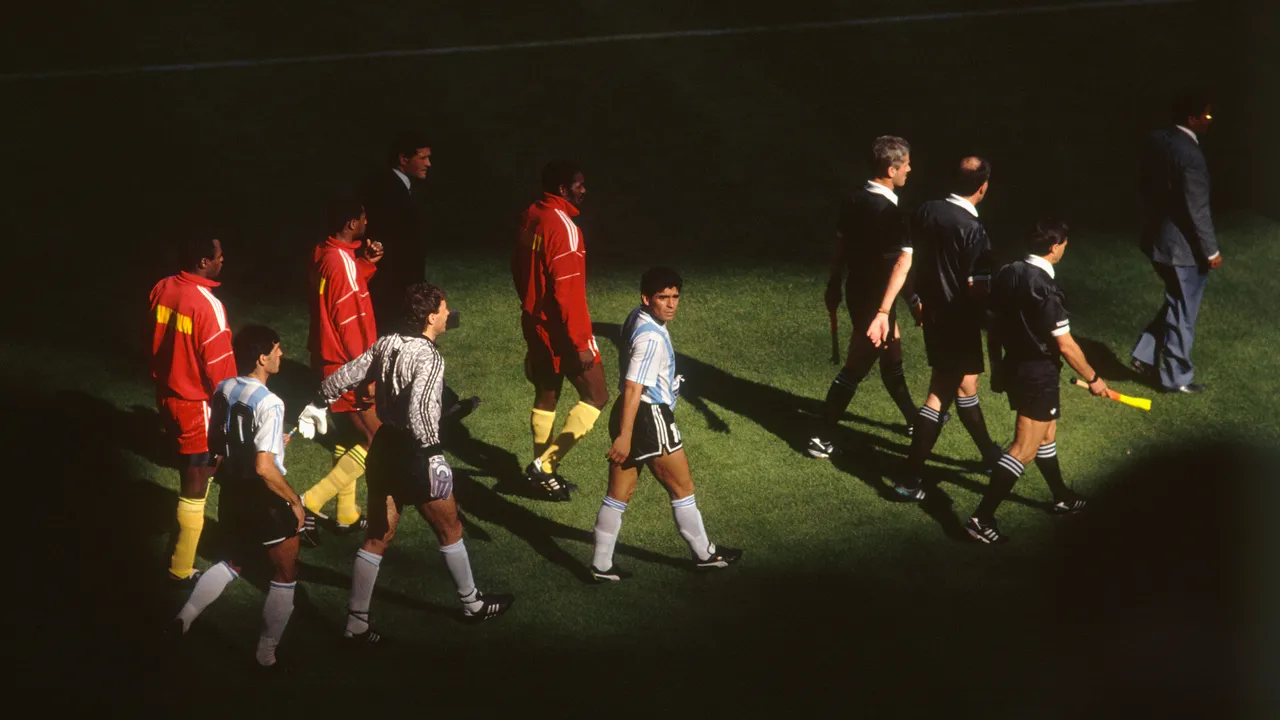
The first time I watched Argentina play live, I cried. It was the opening match of the 1990 World Cup, in Italy. I was six years old, sitting with my twin brother in our grandparents’ living room, thousands of miles away, in Kolkata, India. Our anticipation had been building for months. We were enamored of the Argentinean team and its talismanic star, Diego Maradona, whose exploits, which had led Argentina to victory in the previous World Cup, we watched repeatedly on VHS cassette. We would thunder around our family garden emulating the diminutive, mop-haired forward, our limbs flailing as we zipped past phantom opponents, tumbling into the grass like Maradona did when brought down, as he often was, by exasperated defenders. At bath time, we snapped our towels in the air, aping the footage we had seen of a victorious, bare-chested Maradona jumping in his team’s locker room and singing “¡Vamos, vamos, Argentina!” But, during the opening match, in Milan, against Cameroon, there was no triumph: the unlikely African side achieved one of the most famous upsets in World Cup history, grinding out a 1–0 victory against the lacklustre Argentineans. While relatives looked on in bemusement, my brother and I burst into tears, inconsolable. (We ended up crying again when Argentina lost to West Germany in that World Cup’s final.)
Read more The A.I. Gender Gap Meets the Parenting Gender Gap
For much of the decades since, I’ve carried that strange grief for, and devotion to, a country that’s not my own. So have many others: a vast portion of humanity, numbering in the billions, finds itself stateless at the World Cup. I spent my childhood and much of my adult life as a citizen of India, which has never qualified for the tournament. Argentina filled a void. Embodied by Maradona, successive Argentinean national teams played with flair and toughness and an element of chaos, often on the edge of nervous breakdown. The team’s dramas coincided with years of wider chaos in the country, as cycles of hyperinflation and bailouts bedevilled its economy. As I grew older, I felt a sort of kinship with Argentina’s people, and an admiration for their fanaticism; I also just loved the swagger of multiple generations of attackers, from Maradona to the superstar who surpassed him, Lionel Messi, and many lesser-known, but hardly less dashing, talents who played in their shadows. Argentina fans, meanwhile, are unique in all sports—other countries have fan bases that get loud, but a stadium full of Argentineans activates something primordial. Their songs crescendo in waves, surging like radio static, echoing like a drum. You could spend hours on YouTube listening to the chants of various Buenos Aires club teams, marvelling at the atmosphere, which pulls in legions of tourists.
The albiceleste, as the Argentinean national team is known, are beloved all over South Asia, but especially among Bengalis, who are soccer crazy. Every four years, slums in Kolkata and in Dhaka, the capital of Bangladesh, get painted over in the respective colors of Argentina and Brazil, soccer powerhouses that have been embraced with astonishing fervor across the Global South. Maradona and Messi have paraded through Kolkata on multiple summer tours, mobbed by thousands at the airport and on the streets, hailed as gods coming down to earth. Huge statues of both players were erected there. (Last month, the seventy-foot fibreglass-and-iron replica of Messi was deemed unsafe and taken down.) When Maradona died, in 2020, after a lifetime of substance abuse and other poor choices, candlelight vigils and shrines sprung up across the city; the state government in Kerala, another soccer hotbed, in southwest India, declared a two-day period of official mourning. In 2011, my brother and I were among more than seventy thousand people who went to see Messi’s Argentina play a friendly against Venezuela inside Kolkata’s cavernous Salt Lake Stadium. The stands were a sea of blue and white, with no Venezuela shirts in sight. Everyone, it seemed, was there for Argentina, for Messi, for a crumb of the communion they otherwise never got to taste.
I assume many who were in that crowd were glued to televisions on Wednesday, when Argentina overcame a deficit to beat England in the World Cup semifinal, book its place in the tournament’s upcoming final against Spain, and set up the possibility of winning consecutive titles, the first country to do so since Brazil, in 1958 and 1962. Messi, in his sixth, and surely his last, World Cup, pulled the strings against an English side that erred tactically; he ended up assisting both the equalizing and winning goals. Argentina’s fans danced and sang in their seats long after the match ended, in Atlanta; in Buenos Aires, thousands converged in celebration by the capital’s iconic obelisk. The Fox telecast in the United States also broadcast images of a heaving pro-Argentina party in Dhaka, where the final whistle had blown at 3 A.M.
I no longer count myself in their cohort. If there’s a villain of this World Cup, it’s been Argentina, a defending champion who bullied its way through most of the tournament, breaking hearts at each turn with last-minute winners. After nearly losing, in what would have been a Cinderella upset, to a completely unheralded Cabo Verde, Argentina benefitted from questionable refereeing decisions in subsequent victories over Egypt and Switzerland. Speculation abounded online about a conspiracy to return Messi to the final. Social media has teemed with unsavory videos of Argentinean misbehavior in the stadiums, including fans hurling racial epithets at a Black American influencer and showering Egyptians with beer. Two years ago, a couple of Argentinean players had to apologize after being filmed singing a song that denigrated the African origins of many on France’s team; some Argentinean fans still dust it off, as they do with other songs mocking the poverty of Brazil’s favelas. Last week, Eduardo Feinmann, a prominent and controversial Argentinean journalist, said on television that he found Mexicans “detestable” and scoffed at “the envy Mexicans have for Argentineans—not just in soccer, in everything.” The Mexican President, Claudia Sheinbaum, waded into the fray, describing his remarks as “outrageous.”
Though Argentina’s fans were as boisterous and ubiquitous as ever, the team played little part in the scenes of happy nationalism that will be remembered long after this World Cup is over: the Viking-helmeted Norwegians who “rowed” in unison through the New York City subway and Times Square; the kilt-clad Scots who emptied Boston of its lager; the Japanese who charmed everyone by helping, en masse, to clean up the stadiums where they attended games; the startling bonhomie between visiting South Koreans and their hosting Mexicans; the striking figure of Vozinha, Cabo Verde’s itinerant, forty-year-old goalkeeper, who put his tiny nation on the map when he thwarted Spain in the group stage and staved off Argentina till extra time—heroic feats that saw him earn more than fifty times as many followers on Instagram as there are inhabitants of his country. Argentina’s supporters, meanwhile, lorded their success over others as their team kept winning with a crushing inevitability.
Read more An Idea for Democrats to Keep It Together in 2028
At this point, there’s little debate that Messi is the greatest player of all time. Still, he now leaves me cold. He is a titan of our disenchanted age, on display in every possible medium and format, but utterly boring off the field, insulated behind layers of corporate branding and an army of P.R. professionals. Maradona, on the other hand, was a charismatic populist, a scalawag from a shantytown, irrepressible and impudent. His most infamous goal—when he illegally knocked in the opener in the 1986 quarterfinal against England with what he himself dubbed “the hand of God”—would have been swiftly ruled out by the video-assisted-refereeing technology that has reshaped the experience of watching soccer these days. But that successful act of cheating is central to Maradona’s legend, as is his defiance in the aftermath. (To be sure, he did also score—legitimately—one of the greatest goals ever, in the same game.) He saw Argentina’s victory over England as justice for his country’s humiliating defeat by the British in the war over the Falkland Islands. “We blamed the English players for everything that happened, for all the suffering of the Argentine people,” Maradona wrote in his autobiography. “This was revenge.”
That image of Maradona as an avenging angel, as a tribune of a wronged people, transcended borders. His fame grew in the southern-Italian city of Naples, where he turned up in the mid-eighties to play for the city’s local club, Napoli, which had not won anything in recent memory, and whose supporters chafed against the bigotry of northern Italians. “It had been more than half a century since this city, condemned to suffer the furies of Vesuvius and eternal defeat on the soccer field, had last won a championship, and thanks to Maradona the dark south finally managed to humiliate the white north that scorned it,” the late Uruguayan author Eduardo Galeano wrote. “In the stadiums of Italy and all Europe, Napoli kept on winning, cup after cup, and each goal constituted a desecration of the established order and a revenge against history.”
Now Messi’s Argentina is the established order, the Goliath shoving the heads of all other challengers in the dirt. At the final, on Sunday, Argentina’s libertarian President Javier Milei, and his far-right fellow-traveller, U.S. President Donald Trump, will likely be seated together. Spanish Prime Minister Pedro Sánchez is not expected to attend—Spain’s king will represent the nation from the stands—which is probably for the best. Trump has repeatedly attacked Sánchez’s center-left government, and, last year, Milei stoked a diplomatic feud when he denounced the “socialist scum” in power and seemingly encouraged Spaniards to exact violence on their political leadership. Milei hasn’t shied away from commenting on soccer, declaring earlier this year that “the only left that works” is Messi’s left foot. The Argentinean star, for his part, is apolitical and circumspect—a significant departure from Maradona, who had a famous friendship with Fidel Castro.
Messi goes to New Jersey, where the final will be played, on the cusp of overwhelming glory. One of the main songs in the Argentinean repertoire this summer has been about claiming the “fourth star,” a nod to the possibility of winning a fourth World Cup. There’s a line about doing it for Maradona, for the Falklands, and for the last tournament appearance of Messi. Tens of millions inside and outside Argentina will be belting it out during the game. I won’t be one of them. ♦