 By admin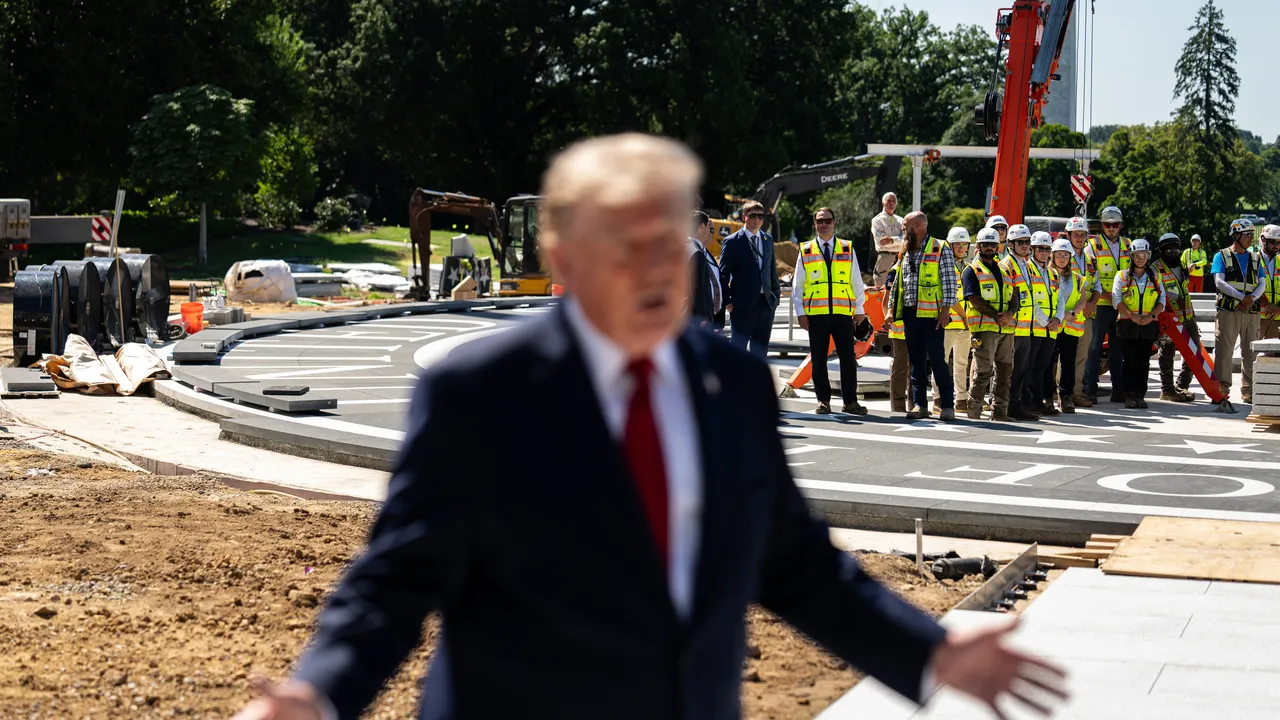
For more than a hundred and seventy thousand Salvadorans who have been in the United States for decades, September 9, 2026, was supposed to mark a cataclysmic event. The special dispensation that made it possible for them to remain in this country lawfully, known as Temporary Protected Status, was due to expire. If the Trump Administration refused to renew it, the government would officially strip them of their legal basis to remain here. “I’m literally buying luggage,” Julia, a thirty-seven year-old who has lived in the U.S. since she was ten—and who asked not to use her real name—told me at the start of that week. “I have one hour to get out of the Titanic before it sinks.”
Read more Mayors vs. Nationalists
At the start of Trump’s second term, more than a million immigrants from seventeen countries had Temporary Protected Status, which has allowed them to live and work in the U.S.legally without fear of arrest or deportation. When T.P.S. was created, in 1990, the idea was that it wouldn’t become a permanent status; recipients would have to periodically renew it, until the U.S. government determined that their home countries were safe or stable enough for them to return to. The first country to receive the designation was El Salvador, near the end of its twelve-year civil war. Over time, owing to major calamities such as the 2010 earthquake in Haiti and a civil war in Syria, immigrants from other countries received T.P.S. As the list of countries grew, Republican and Democratic Administrations kept extending the individual designations for many of them. (In the case of El Salvador, the government issued a new T.P.S. designation in 2001, following a major earthquake.) Partly, this was a result of failed efforts in Congress to reform the immigration system and, in the process, to give T.P.S. holders other avenues by which to gain permanent legal residency.
Eva, a Salvadoran mother of two who asked not to use her real name, came to the U.S. in 1995, at the age of fifteen. She received T.P.S. in 2001, shortly after getting married. Her life instantly changed with T.P.S. “We started to be counted in the system,” she told me. She was living in Florida, where undocumented residents couldn’t get driver’s licenses. “The way you move through the immigration system is with numbers,” she said. “You get a Social Security number; you get a driver’s license. With a number, you’re no longer invisible.” Her family bought a car and secured a mortgage; she gave birth to a son, then a daughter. It was hardly lost on her that her legal status was temporary. But, she told me, “Imagine if, year after year, I said, ‘I’m not going to buy a car because I have a temporary status and possibly in another year I’ll have to leave; or I’m not going to get married because in a year I’ll have to return; or I’m not going to have my children because I may have to leave.’ No one can live like that.” By 2010, she said, “I’d lived here longer than I lived in the country where I was born.”
Donald Trump had tried to cancel Salvadoran T.P.S. once before, in 2018. Roughly a hundred and ninety-three thousand American children then had parents who were Salvadoran T.P.S. holders. It was the first time Eva confronted the fact that the government could, with a single decision, set her life adrift. Legal-advocacy groups sued to block the President’s order, and a federal court eventually found that the Administration had attempted to cancel the program without following adequate administrative protocols. For Eva and her children, though, the reprieve was brief. The following year, her husband, who didn’t have T.P.S., was deported. “We were fighting and fighting to be here,” she told me. “How could I explain to my kids why we were still living in this country?” Late this summer, as the September 9th deadline approached, Eva told her daughter that they had two options: either she could join Eva in El Salvador, a country she had never visited, or she could move in with her older brother, who would have to become her legal guardian. “I don’t want the same thing to happen to them that happened with their father,” Eva told me.
Then September 9th came and went. The Department of Homeland Security, which administers T.P.S., posted a cryptic statement on its website. “An announcement on El Salvador’s TPS will be made at the appropriate time,” it read. “Until such announcement is made, Salvadoran individuals present in the U.S. under TPS retain protection including work authorization.” Stranger still, according to multiple former D.H.S. officials with close ties to the department, the memo formalizing the termination had been prepared more than a month earlier. It was sitting on the desk of Markwayne Mullin, the Secretary of Homeland Security. Notices informing beneficiaries that their status would be ending had already been issued and were ready to be sent to a printer. “They wanted to be able to say that people were on notice that they were removable,” one of the officials told me. “On the D.H.S. side, everything was done and ready. The Secretary had no reason to sit on it unless the White House told him to.”
Top Trump officials have left little doubt about their hostility to the program. Earlier this summer, the Supreme Court issued a new ruling that gave the Administration wide latitude to begin cancelling people’s status. Last month, the President ended T.P.S. for about three hundred and fifty thousand Haitians; it has also terminated the status for another seventy-four thousand people from Afghanistan, Cameroon, Honduras, Nepal, and Nicaragua.
Why would the government suddenly delay plans to do the same for Salvadorans? “It just came down from the White House,” Mark Krikorian, the head of a prominent anti-immigration think tank in Washington, told Politico. “They may just be thinking, let’s make this go away for six months.”
It’s been three weeks since the deadline passed, and the Administration has still said nothing publicly, either about its reasoning or what recipients can expect. According to Politico, the government of El Salvador, a close Trump ally, advocated for more time. The country’s authoritarian President, Nayib Bukele, has been wary of championing T.P.S., since he wanted to emphasize his success in making El Salvador safer by ridding it of violent street gangs. Yet he was also likely mindful of the economic repercussions of forcing nearly two hundred thousand Salvadorans to leave the U.S., given that nearly a quarter of the Salvadoran economy is funded by remittances sent by immigrants living here.
Read more Hockey Dads and Hockey Sons
At the same time, there was another lobbying push, mounted by U.S. advocacy groups, which began months before the expiration deadline. Stephen Miller, the President’s top domestic-policy adviser, wanted to cut legal immigration in all forms, regardless of the economic fallout. But others in the White House told lobbyists that they needed to show a business case for extending T.P.S. This has become a familiar routine during the President’s second term: the nativist wing, governed by Miller, targets immigrants with arrest or the cancellation of their legal status, while a more traditional, pro-industry contingent, under pressure from interest groups and Republican loyalists, tries to minimize the damage to employers. In the summer of 2025 a top official at Immigration and Customs Enforcement told agents to “hold on all work site enforcement investigations/operations on agriculture (including aquaculture and meat packing plants), restaurants and operating hotels.” The move, according to the Times, followed an appeal by Trump’s Agriculture Secretary, Brooke Rollins, who promptly came under attack from immigration hard-liners within the President’s far-right base. (Afterward, she reportedly asked outside groups active in Republican politics to take out ads defending her conservative bona fides.) Last week, Republicans in Kansas, Oklahoma, and Texas publicly pleaded with the Administration to temper immigration arrests on cattle ranches, warning about rising beef prices.
While efforts to make pragmatic appeals on immigration have mostly failed to move the President, the Salvadoran case was different. This time, among the groups pushing Trump to pause his plans were lobbyists from the construction industry, which is heavily reliant on labor supplied by T.P.S. holders, especially in the capital. The Washington metropolitan area is home to the second-largest Salvadoran population in the country, totalling upward of two hundred thousand people. When Trump attempted to cancel T.P.S. in his first term, a fifth of all construction workers in the district were protected by the designation, and most of them were Salvadorans. “What would happen to the local construction sector if we lost T.P.S. holders?” Julio Palomo, the business manager of a labor union in the D.C. area, told me. “There’s so much construction, so many government contracts, because it’s D.C.”
Clark Construction, the company in charge of building the President’s new ballroom, for example, employs a significant number of Salvadorans with T.P.S. A spokesperson for Clark told me, “T.P.S. workers have not been involved in the construction of the ballroom,” adding “The status of T.P.S. workers does not have an impact on the ballroom.” When I asked the White House if Trump’s ambitious building plans for the capital might be delayed if he cancelled Salvadoran T.P.S., an official said, “There are no individuals with T.P.S. status working on the East Wing modernization construction project.” Still, three sources with knowledge of the situation told me that the White House had at least been explicitly warned that cancelling T.P.S. would disrupt construction projects in Washington.
There are signs that such appeals had a direct impact on the White House. At the end of the day, on September 9th, the D.H.S. added the language on its website specifying that Salvadorans with T.P.S. should “retain protection” to work pending any further announcement. The reason for the clarification, a former D.H.S. official told me, was that employers needed explicit confirmation that they weren’t violating any laws by continuing to use Salvadoran T.P.S. holders. “It’s unprecedented that the government would make a statement like this without a formal decision,” the official told me.
It’s still too early to parse the consequences of the current delay. The program is supposed to automatically extend for half a year if no decision was made to terminate T.P.S. at least two months before the expiration deadline. Because a decision appears to have been made in the Salvadoran case, then paused, without any public clarification, the situation is more ambiguous. “In D.H.S.’s view, there’s no consequence for not having announced the decision yet,” Jessica Bansal, an attorney for the National T.P.S. Alliance, told me. At D.H.S., a team of lawyers has already begun investigating how the Secretary could end T.P.S. sooner. The plan, according to one of the former department sources, has always been to cancel T.P.S. regardless of the current delay.
Julia, who’d been packing her suitcases on the eve of the cancellation, had also purchased a plane ticket to El Salvador, but she delayed her plans to see what would happen. “My employer didn’t accept Trump’s extension, because you can’t exactly take a website printout to the H.R. office,” she told me. “The Department of Motor Vehicles also didn’t accept it.” The confusion seemed to be widespread. The public-school district in Montgomery County, Maryland, laid off fifty-four staff members on September 9th, after receiving notice from the federal government, a month earlier, that their T.P.S. would expire; the next day, they were reinstated. “Late Wednesday, the federal government posted an online update indicating that employees with this work status may continue working while further federal guidance is pending,” the district wrote in a letter to its employees. “We are very happy to welcome you back.” ♦
Read more New Kinds of Trad Wife I Could Be