 By admin
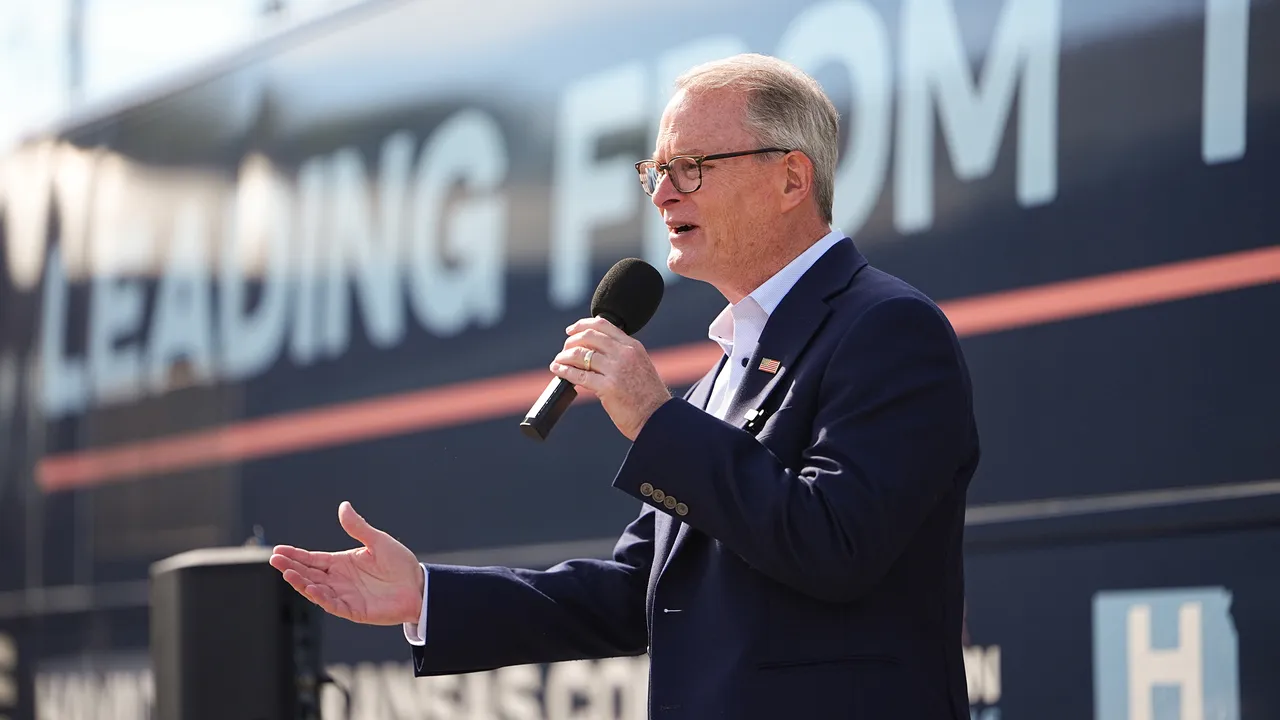
One recent Sunday, Adam Hamilton, the Kansas pastor who has been running an unexpectedly competitive Democratic bid for U.S. senator, was scheduled to visit four churches around Kansas City. As he settled into a pew at Oak Ridge Baptist Church, he was fretting. “I want to stay for the entire worship service,” he said.
Read more How Jim Morrison Surmounted Tragedy and Skied Down Everest
People milled around the sanctuary, greeting one another warmly. Nearly everyone there was Black; all the churches in the day’s lineup were Missionary Baptist, a historically Black denomination. Hamilton, wearing a neatly ironed blue suit and carrying his personal Bible, greeted parishioners warmly, as he has done nearly every Sunday morning of his adult life. Finally, Ricky Turner, the church’s pastor, called him up to stand by the podium. “Adam knows that we don’t give the mike to politicians,” Turner said. But Hamilton was not just any politician, he said: “This is a man of God.” When Turner’s daughter was in a car accident recently, “I got a call from Adam Hamilton,” he said. “You know what he did? He just started praying for me.” The congregation cheered.
Much has been made of the fact that Democrats are running avowedly Christian candidates in November’s midterms. There’s James Talarico, the Presbyterian seminarian running for the U.S. Senate in Texas, who has got in trouble for such theological provocations as “God is nonbinary.” Or Rob Sand, the Iowa gubernatorial candidate, who likes to say that “Jesus is for the little guy.” But no other candidate is as well established in the Christian world as Hamilton. He is the founding pastor of the Church of the Resurrection, which, with twenty-three thousand members across nine locations, is the country’s largest United Methodist congregation. His books and Bible studies are read all over the country.
Less than a minute after Turner finished speaking, Hamilton was out the door, moving so fast that a normal person would have to jog to keep up. After a twenty-minute drive, he strode into Forest Grove Baptist Church, where about forty people were at the morning worship service. Here, Hamilton got to take the pulpit. “My deepest desire is to help people know Christ,” he said. As he’d watched the news in the past year and a half, he said, he’d thought, “This does not look like the kingdom of God I have prayed for and preached for my entire life.” During Lent, he and his wife fasted every day, and they decided that he should jump into the race after Easter. “I’m going to ask you not for your vote—I’m going to ask for your prayers,” he said. “That God will continue to guide me, strengthen me, and help me—and, if I do get elected on November 3rd, that God would use me to push back the darkness in our country.”
Polling suggests that Hamilton may just win. President Donald Trump’s policies have been hard on Kansas. Diesel prices are sky-high. Lower tariffs on beef have hurt cattle ranchers. ICE recently raided meat-processing plants in several cities in rural southwestern Kansas. Trump even threatened to ban jets made by Bombardier, a Canadian company; the company’s American headquarters are in Wichita.
Roger Marshall, the incumbent Republican senator, has backed Trump on almost all these policies. He has also developed a rough reputation of his own. This fall, the Times published an investigation showing that Marshall, a retired ob-gyn, had sued more than seven hundred patients for missing payments; eighty-one were arrested. At the Kansas State Fair in September, Marshall protested that he had a business to run: “We had three hundred employees.” The audience booed.
Kansas is a red state, where a plurality of voters are registered Republicans, but it has an independent streak. In 2022, after the fall of Roe v. Wade, it was one of the first states to consider a referendum that would have led to an abortion ban; the measure failed. The governor, Laura Kelly, is a Democrat; another Democrat, Kathleen Sebelius, served as governor from 2003 to 2009 and has won four statewide races. She thinks that her success can be replicated this year. This is “the first time in my life that I have seen people being able to connect the dots very clearly,” she told me. “It is people understanding: the President launched a war in Iran, and my gas is unaffordable.” Bob Beatty, a political-science professor at Washburn University in Topeka, told me, “For a Democrat to win statewide, they need to win in northeast Kansas—which is Johnson County especially—by twenty-plus points, and then not get slaughtered in western Kansas.” Johnson County, south of Kansas City, is where twenty-three per cent of the state’s registered voters live. It’s also where COR is situated.
Especially after the bruising 2024 election, Democrats desperately want to win in red states. Hamilton is like an unexpected miracle: he entered late and mounted a surprisingly strong campaign. Improbably, whoever wins this seat may end up determining which party controls the Senate. Still, candidates like Hamilton are an uncomfortable fit for the Democratic Party. And, perhaps just as important, the Democratic Party may be an uncomfortable fit for Hamilton’s church.
Hamilton grew up in the southern suburbs of Kansas City, without much religious instruction. When he was a teen-ager, a street preacher convinced him to visit a Pentecostal church, and he started attending regularly. At fourteen, he asked to give his life to Jesus. After high school, he married a girl he had met at church, and then began his studies at Oral Roberts University, a well-known Pentecostal college. But Hamilton craved a broader intellectual tradition for his faith. He eventually discovered the eighteenth-century theologian John Wesley, the founder of Methodism, who promoted a combination of social activism and personal piety.
After seminary, Hamilton began building a church, holding the first services in the chapel of a funeral home in 1990. To increase attendance, he sent postcards to every address in the surrounding city of Leawood, Kansas. When someone new came, he would stop by their house the next day to give them a coffee mug, a process that later became known internally as “mugging.” By the early two-thousands, the congregation was well into the thousands. Hamilton usually preaches forty Sundays a year, with his sermons beamed into other locations on huge video screens.
The United Methodist Church has historically held together a wide theological spectrum. “Methodists are chameleons,” Mark Holland, a pastor who served as mayor of Kansas City, Kansas, told me. “In the Northeast, we look a lot like the Unitarians. In the South, we look a lot like the Southern Baptists.” Several people told me that Hamilton is from the more evangelical side of that spectrum. It’s a fraught description: the term has become associated, at least in some people’s minds, more with a political identity than with a religious one. On our way out of Oak Ridge, Pastor Turner said that his parishioners should want to put Christians in office, and “not just evangelicals!”
As I hurried after Hamilton, he agreed to the term, but with caveats. “ ‘Evangel’ means good news,” he told me. “I’ve always considered myself what I would call a progressive evangelical, and that is somebody who cares deeply about people coming to faith in Christ, experiencing what Jesus talked about—the new birth—being filled with the Holy Spirit, and then being committed to love their neighbors as they love themselves.”
Democrats are often willing to go along with sentiments like “love your neighbor.” Even progressive crusaders like Elizabeth Warren pepper their speeches with references to “the least of these,” from Matthew 25, or the parable of Jesus flipping the money changers’ tables, from Matthew 21. But anything more Jesus-y than that is uncommon. “I’ve been here for a while, in Congress,” Emanuel Cleaver, a U.S. congressman from Kansas City, Missouri, who is also a Methodist pastor, told me. “One of the things that I learned early on was that Democrats have a nervousness around their love for Jesus.” (Hamilton’s campaign declined to make time for the candidate to speak about his faith ahead of the election.)
There’s been an interesting religious dynamic this midterm cycle. Michael Wear, a former Obama Administration official who runs the Center for Christianity and Public Life, told me, “Hamilton, Talarico, and so many of these candidates who are leading with their faith have had to spend a lot of time on the campaign trail, and a lot of money, making clear that they are not one of those Christians.”
Read more Can Democrats Win Back Labor?
After Hamilton got done church-hopping, volunteers held a get-out-the-vote event at a brewery not far from COR. At the bar, a group of forty-something regulars were posted up watching the Chiefs game; they hadn’t come for the Hamilton event, but it was a conversation piece. “I one hundred and ten per cent recognize the hesitation of electing a pastor, because of the Christian nationalism being put forward by the right wing,” a woman named Julia said. She had cast an early ballot for Hamilton, but the pastor part of him gave her pause. “I am concerned about the infiltration of religion into politics in any capacity,” she said.
On the campaign trail, Hamilton loves to talk up the political diversity of his church: according to COR’s internal numbers, it’s about forty per cent Republicans and forty per cent Democrats, with most of the rest being Independents. He has leaned into the story of his own independence, noting that he only recently switched his voter registration to Democrat. This is a little misleading. Hamilton preached at a prayer service following Obama’s second Inauguration; he also served on the President’s Advisory Council on Faith-based and Neighborhood Partnerships.
Hamilton pitches his church as a place for thinking people. Shere-Ling Kraus-Yao, a church member who attended the get-out-the-vote event, told me that she likes that you “don’t check your brain at the door when you come in.” It is central to Hamilton’s identity that COR is a place where people can disagree well about hard things. This attitude is not necessarily in vogue in contemporary politics. “After President Obama, the Democratic Party—like the Republican Party—grew much more ideologically exclusive,” Joel Hunter, the former pastor of a Florida megachurch called Northland Church, who served as an adviser to Obama, said. “Neither one of them was trending toward a big-tent standard.”
Take Hamilton’s writing on abortion. In his book “Seeing Gray in a World of Black and White,” he writes that abortion needs to be safe and available. But, he continues, “I believe conception is a miraculous event in which we have become co-creators with God, and is to be violated only under the most extreme of situations.” He favors the morning-after pill, which works for up to three days after unprotected sex, over surgical abortion. And, he says, “the church must, with compassion and love, articulate to its members the reasons they should choose to carry a child to term when the pregnancy is unplanned.” It’s rare these days to hear elected Democrats at any level expressing this kind of view.
Yet Hamilton’s opponents have cast him as “too liberal for Kansas.” They have attacked him for his “inclusivist” approach to salvation, which suggests that God may still save people who don’t explicitly recognize Jesus as the Son of God; Senator Ted Cruz called this “heretical.” Hamilton once noted in a sermon that cattle ranching exacerbates climate change. This was turned into a line about how he wants people to repent for eating beef; Hamilton ran an ad in which he tucks into a steak. More seriously, the Marshall campaign has focussed on a situation from two decades ago in which two boys who participated in a COR retreat alleged that they had been sexually assaulted by an adult volunteer. The church investigated, but did not immediately contact the authorities, which Hamilton now says he should have done.
Republicans have also tried to associate Hamilton with transgender activism; during a rally in Wichita, Trump claimed that he believes in “making children transgender.” But Hamilton has expressed fairly conservative views on this issue. “There are two genders, male and female,” he said during a debate in October. “I have a twelve-year-old granddaughter. I don’t want biological men or boys competing against her.” Hamilton is now fully affirming of same-sex marriages, but it took him a while to get there: in 2004, after a sermon during which he said that “I don’t know” the right answer on this issue, more than a thousand people left his church, most of whom felt that he had capitulated on a core Biblical teaching.
In recent years, the United Methodist Church has faced tremendous internal disagreement over L.G.B.T.Q. issues; those debates, which culminated in a 2024 decision to ordain gay clergy and to effectively allow same-sex marriages, led to more than eight thousand churches leaving the denomination. This ordeal has become another Republican attack line. “Was he leading from the middle when one out of four churches left his denomination?” Marshall said during October’s debate.
It’s a little surreal to see complex denominational battles become fodder for campaign ads. Hamilton does have significant influence within the U.M.C., but he has generally used it to ease factional differences. “All through these debates around human sexuality and the potential splits in the United Methodist Church, he’s always tried to have broad shoulders to hold the center together,” Brett Opalinski, a Methodist pastor and a professor at Emory, told me.
For others who followed the U.M.C. drama closely, though, Hamilton’s actions made him seem less trustworthy—as though he were willing to bend on core theological principles. Many of the churches that left the U.M.C. describe themselves as “traditionalists”: they believe that a faithful reading of the Bible does not support same-sex marriage. Brad Kirk, a Methodist pastor in the rural town of Kingman, Kansas, was once part of a young pastors’ network that Hamilton ran. His church left the U.M.C. several years ago, and he now knows a number of people who feel that they can’t vote for Hamilton because of his approach to Scripture. “The whole idea of electing someone who will represent a group of people is that they will stand firm,” Kirk told me, emphasizing that he was speaking for himself, not his church. “It’s that accommodation that bothers me most.”
Thirty-six years ago, Linda MacRoberts got a postcard about the Church of the Resurrection’s first Christmas Eve service, and she decided to go. She was taken by Hamilton’s message, and became one of COR’s founding members. “He is, in the very best sense, a true believer,” she told me. But when she heard that he was running for Senate, “I was very ambivalent about it. I thought he’d be swimming with sharks,” she said. She doesn’t like that his campaign has run ads about political scandals “like Jeffrey Epstein, and they’re showing this dark picture of Roger Marshall.”
Before Hamilton entered the Senate race, he was planning to retire from COR in 2030. His run has left the church trying to navigate its new political role. During the Chiefs game, a hundred or so people gathered at the church’s main location, in Leawood, for 5 P.M. worship. “You might be wondering, ‘Where is everybody else tonight?’ ” Joshua Clough, an associate pastor, said. “You are the true faithful,” he joked. “Your spot is deserved in Heaven.” A stained-glass Jesus loomed over everything.
Afterward, Clough told me that the church has “tried really hard to separate the political campaign from the work that the church has always done.” It’s been frustrating for staff to see Hamilton’s careful, nuanced approach get pilloried as the agenda of “a radical-left lunatic,” which is what the President recently called him during the rally in Wichita. “Our posture isn’t to defend everything but to live our values out through serving others,” Clough said. He sees the campaign as an opportunity, he added. “We get to share a different narrative about Christian faith that most never hear.” ♦
Read more Did an Alternative-Medicine Guru Accidentally Kill Patients?