 By admin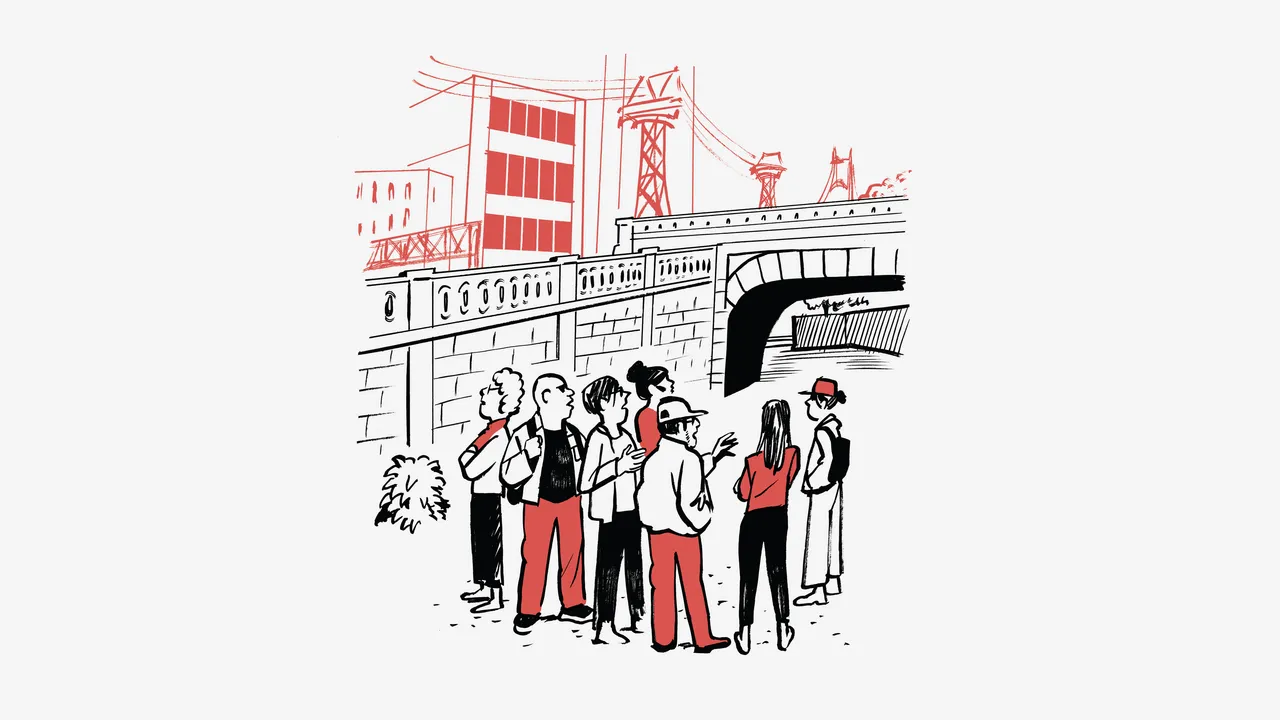
“In New York City, the streets are your living room,” Jack Espel said the other day, at a coffee shop on East Fifty-ninth Street. Espel, a middle-school history teacher, is part of a group of Midtown East residents who are organizing to transform what they call “derelict parks” into cheery public spaces. That day, they’d met to discuss their goal of turning two dilapidated lots into pocket parks.
Read more Nolan Wells’s Family Still Wants Answers
Sean Basinski, a semi-retired lawyer who heads the group, was at the center of a recent local kerfuffle: Guastavino’s, a seven-thousand-square-foot event venue situated under the ramp to the Queensboro Bridge, had been treating a small park out front as its private property—roping it off and shooing away pedestrians. “During COVID, I brought some kettlebells over to do a workout, and the guard kicked me out,” Basinski said. Later, he tried to use the plaza as a backdrop to photograph some shoes he was selling on eBay, and was again told to leave. “We had words,” he said.
“I did some digging and found out that the park belongs pretty obviously to the City of New York,” Basinski said. He filed a class-action lawsuit against Guastavino’s, alleging “brazen and illegal seizure of public space” and stating that, on a “nearly daily basis,” Guastavino’s evicts the “general public from a public plaza” by selling and marketing “exclusive access to . . . their ‘private garden.’ ” Guastavino’s swiftly removed the “Private Property” signs.
Parks are few and far between in midtown. “We’re park-starved,” Basinski said.
Justin Nuttall, a data manager who grew up nearby, was at the coffee-shop meeting. He described leaving the neighborhood for the first time as a child: “We went to Brooklyn as a family, and I remember being afraid of the grass because I didn’t know what it was.”
Susan Blackwell, a retired copywriter who lives on Sutton Place, chimed in. “My husband grew up on Fortieth and Third, and they used to walk the dog in Grand Central,” she said. “I don’t think he saw a leaf until he went to camp.”
“It’s so uncool to live here that it’s cool,” Nuttall said. “My wife laughed when I told her I grew up in Midtown East.”
Anna Arima, an event planner who moved from Ukraine, has lived in midtown for twelve years. “I used to work for the mayor in Kyiv, which used to be the greenest city in Ukraine,” she said. “When I moved here, I was looking for a way to beautify the community the way we did in Kyiv.” Her super had told her about Basinski’s group.
Others joined after seeing signs Basinski had posted by vacant lots in the neighborhood. “DOES THIS LOOK GOOD TO YOU?” one read, next to renderings of what the space could become.
Nuttall had done the visuals. “I just messed around with A.I.,” he said.
The group went to look at the space that was on the day’s agenda: two neighboring lots—fenced off and locked—that span Fifty-ninth Street between First and Second Avenues. All that was there was a dirty tennis ball, a few patches of grass, and a crushed beer can. Kevin Eerkes, a member of the group, stopped as he was jogging by. He removed an AirPod. “The pigeons love these lots,” he said. “And we could, too!”
Read more Susan Collins’s Maine Money Machine
The group members nodded. As for what the lots should become, Nuttall said, “Well, that has to be crowdsourced when the city finally lets us do something.”
“We’re thinking industrial chic!” Blackwell said. Other ideas were floated: a dog run, an outdoor café.
“Literally just some green for people to lounge on,” Basinski said. “The goal is to get the city to spend the money to turn this into something other than a dump.”
Two years ago, Basinski had had a call with a commissioner at the Department of Transportation, which is responsible for one of the lots. (The spot is a vestige of the Queensboro Bridge’s construction. Originally, tenement buildings stood there.) “He acknowledged the city is not using the space well,” Basinski said. Another D.O.T. rep recently claimed that the lot can’t be repurposed for the public at all. Basinski’s group has collected nine hundred signatures to support the cause. The next step is a meeting with the Community Board. “We’re finally on Board 8’s agenda for next month’s meeting,” he said.
The group was buoyed by a recent local success story. “Did you hear about the Hunter students?” Espel asked. He was referring to the college kids who, in July, had lobbied the city to turn a half block of curb space on East Sixty-ninth Street, by Hunter College, into what they called a “vibrant public gathering space.”
“It’s essentially a few parking spots that the city’s going to let them put some chairs on,” Espel said, dismissively.
“Parking spaces are hallowed,” Blackwell reminded him.
The midtown group has its haters. “Some people say that, if the lots are converted, no one’s going to want to sit there,” Basinski said. “It’s right next to the bridge. It’s noisy.” He went on, “But we’re all already here, next to the bridge. I’m breathing this air, hearing this noise. Let’s at least make it nice.” ♦
Read more The New York Film Festival, Week One: Better Late Than Never