 By admin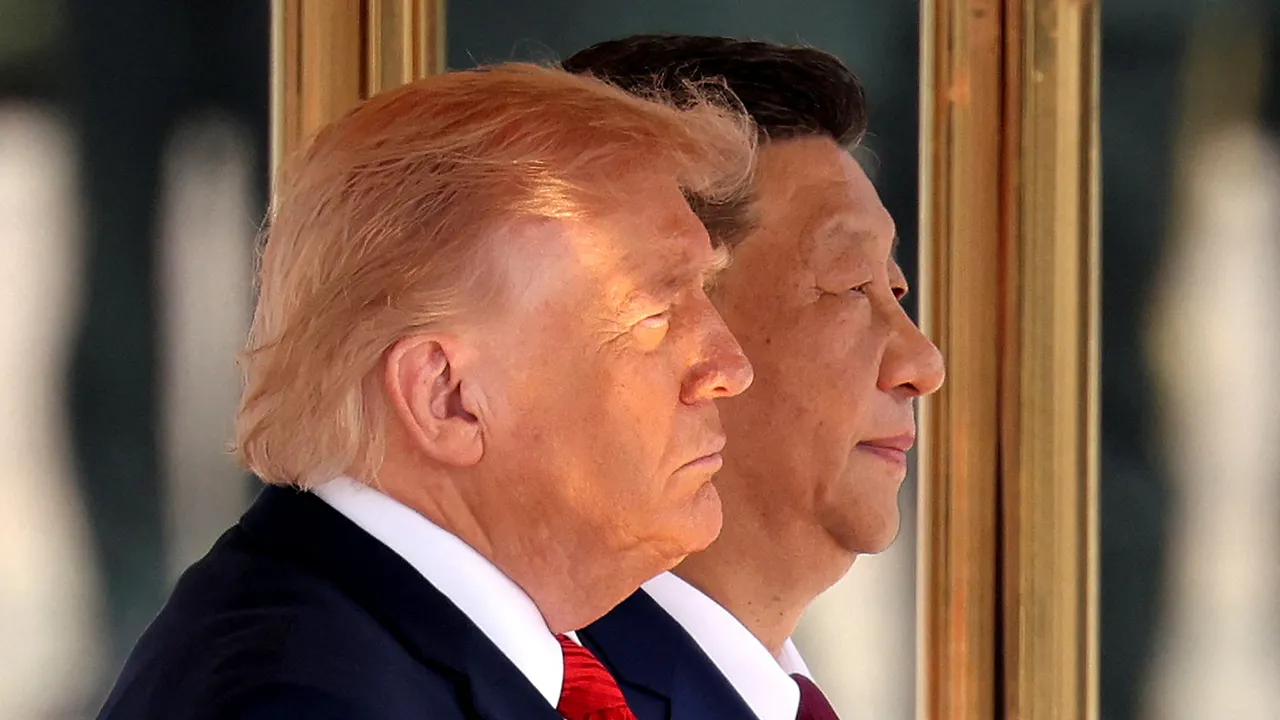
When the plane bearing the Chinese President, Xi Jinping, lands at Joint Base Andrews on Wednesday afternoon, his American counterpart will be waiting for him. U.S. Presidents usually receive heads of state at the White House, but the esteem with which Donald Trump appears to hold Xi, and the weight of this visit from the leader of the United States’ closest peer competitor—the first of its kind in a decade—are apparently such that Trump decided to greet him on the tarmac. On Thursday, when Xi goes to the White House, the two leaders will hear the U.S. Marine Band play both of their national anthems and watch a military flyover featuring a B-2 stealth bomber and four F-22 Raptors. When the President went to Beijing in May, he did not get an airport pickup from Xi, and when Xi later escorted him to the Great Hall of the People, they were met by a group of children, who chanted “Welcome!” and waved Chinese and American flags. Optics are paramount for Xi, who presides over a sprawling but opaque one-party state apparatus, and comes to the United States leaving behind a mounting set of domestic woes, including sluggish economic growth and stubbornly high youth unemployment. But he will begin his time in Washington as Trump’s honored guest, more fêted than leaders of allied nations who have called on Trump during his turbulent second term.
Read more The Fallout of a Charlie Kirk Campus Scandal
What will follow—closed-door meetings between Trump and Xi, with their staffers, scheduled amid the hurried summitry; a state dinner crowded with tech C.E.O.s and other A-listers; a tea involving the Presidents and their spouses, all of it likely covered by a reduced press corps following Trump’s ban on three major media outlets—is murkier. Despite the pomp, expectations for tangible results are low, with Trump and Xi’s personal rapport belying a chasm of distrust and tension between Beijing and Washington.
China has played a central role in the past decade of Trumpist politics. Initially, for Trump the campaigner, China was the embodiment of U.S. folly, a country catapulted to superpower status thanks to the naïveté and the cupidity of the American globalist class, which, a generation ago, opened the doors for China’s manufacturing juggernaut to take over the global economy, hollowing out factories and disappearing working-class jobs in the West. For Trump the President, China was, in his first term, a clear strategic rival to be reined in by tough policies, including the first blows of a trade war that lingered through the Biden Administration, which took a similarly tough, if more calibrated, approach to Beijing. But, in Trump’s second term, his tone has changed—in April of last year, China responded to his unprecedented tariffs with expanded export controls that showcased the dominance of its critical-mineral supply chains, which many U.S. companies depend on. Trump backtracked, and has conspicuously softened his stance. He delayed arms sales to Taiwan, the autonomous island democracy whose return to mainland rule Xi says is a “historical inevitability,” and appears to have tolerated China’s insufficient purchases of U.S. agricultural products that Xi had pledged to fulfill.
Potential positive outcomes from the summit may include the start of a formal U.S.-China dialogue over A.I. and its perils, and an agreement to extend a trade truce reached last October, which saw the Trump Administration scale back some of its tariffs on Chinese goods, and saw China maintain certain exports of critical minerals. (Many Western, Indian, and Japanese manufacturers complain of ongoing difficulties in sourcing these elements.) Friction certainly remains between the two nations—from the Pacific, where U.S. preëminence is constantly being eroded by China’s rise, to wars in the Middle East and Europe, where China is tacitly backing U.S. adversaries—but, lately, Trump prefers to spotlight his admiration for the Chinese President. “He’s a great gentleman. We get along great,” Trump said earlier this month. “We have a very good trading relationship, and, you know, they’re a competitor and all of that, but we have a very good relationship with President Xi.”
Whether Xi is moved by Trump’s bonhomie may be immaterial. Analysts see China working quietly in the shadow of Trump’s blustering disruption. In some sectors, it is gingerly filling the void left by Trump’s America First agenda, including buttressing parts of the global humanitarian system gutted by the Administration’s dismantling of U.S.A.I.D. More broadly, China is gaining ground simply by existing in contrast to Trump’s United States—a more predictable power that’s not launching unprovoked wars, installing puppet regimes in petro-states, or erratically lashing out at longtime friends and partners. (New polling confirms the impression of China’s growing popularity around the world, relative to the United States.) On Tuesday, at the dais of the U.N.’s General Assembly, Trump denounced the institution’s “globalist bureaucrats who nobody ever elected” and its “far-left” agendas, attacking bodies such as its human-rights council, and the International Criminal Court. He laid out possible strikes against Iran, musing, “Do I drive them into hell with no chance of survival and no hope of future greatness or generations?” (The King of Jordan, speaking right after Trump, bemoaned the global instability wrought by the Iran war.) Trump also celebrated his military operation, earlier this year, in Venezuela, to remove Nicolás Maduro from power, asserting that the U.S. “will use our unmatched military might to secure the vital national interests of the United States.” Here was the leader of the global hegemon, reminding the world of his hegemony.
Other world leaders at the General Assembly, including Brazil’s President, Luiz Inácio Lula da Silva, who immediately preceded Trump, took turns offering an alternate world view, extolling the virtues of “multilateralism” and invoking the need for greater coöperation and the bolstering of U.N. institutions. “Sovereignty is strengthened, not diminished, when countries work together to address shared challenges,” Lula, together with Prime Minister Mark Carney, of Canada; President William Ruto, of Kenya; and António Costa, the president of the European Council, said in an opinion piece for the Financial Times on Sunday. They added, “National interests are often best advanced through collective action on such challenges.” That’s an ethos wholly rejected by Trump, of course, but one that suits China, at least as rhetoric. Xi comes to Washington following a tour through Central Asia and South Asia, where he cast China as a driver of a revived global order that engages in multilateralism and offered his now routine critique of great power “hegemonism” —a barely veiled jab at Trump. Beijing, in standard Communist Party jargon, says that it wants to address “global governance deficits,” and for China to be a “responsible major country” that can champion the causes of nations in the so-called Global South which have been underrepresented in the post-1945 international system and hurt by decades of unfair and domineering Western economic practices.
Read more Is Trump’s Latest Press Attack Just Another Distraction?
In fact, governments in the developing world have concerns about Beijing’s designs and practices, but they can’t ignore China’s economic footprint—it is most countries’ biggest trading partner—and they are all, in various ways, trying to hedge against an increasingly unreliable Washington. At a forum in Beijing last week, Singapore’s defense minister, Chan Chun Sing, whose city-state lies at the heart of major global trade, lamented how some powers have “tried to weaponize their economic interdependence”—an implicit criticism of Trump’s tariffs, but also, perhaps, of how China often leverages its significant industrial and supply-chain advantages.
In curious ways, Trump and Xi mirror each other. They “both regard themselves as seminal, if not singular, figures whom history has appointed to fulfill a weighty mandate,” Ali Wyne, a researcher at the International Crisis Group, told me. That is, he said, they see themselves as “insuring that their respective countries regain the greatness squandered by predecessors” because of “corruption, ineptness, and timidity.” Trump has gone about pursuing this reclamation by smashing the trust of close U.S. allies with coercive, bullying tactics. “Historically, Washington saw its alliances as the starting point for international diplomacy,” Rush Doshi, a China scholar at Georgetown University and the Council on Foreign Relations, and a veteran of the Biden White House, told me. “Trump often flips the script, seeing the other great powers—particularly Beijing and Moscow—as the starting point.” That view “suits Beijing well,” Doshi added, since China is averse to treaty alliances, but is eager for the kind of great-power shoulder-rubbing that will be on show this week in Washington. “Trump’s approach, in many ways, is what they have long had in mind,” he said.
What does Xi now seem to have in mind? Kevin Rudd, a former Prime Minister of Australia and a noted China expert, points to the centrality of Xi’s never-ending campaign to consolidate and extend his own power, buttressed by his staunch Marxist-Leninist bona fides and his ruthless focus on preserving and controlling the ruling Communist Party, whose cadres he has frequently purged. Jessica Chen Weiss, a former State Department official and a professor at the Johns Hopkins School of Advanced International Studies, argued on a recent podcast that China favors “a small-C conservative” norms in the international system, in which non-interference in the affairs of other sovereign states is paramount, suggesting that China’s expansive nationalist project parallels an America First agenda. Ryan Hass, a China expert at the Brookings Institution who served in the Obama White House, recently wrote that Beijing “views America as declining but dangerous,” and that Xi is “content to patiently accumulate power and influence until such time as the country becomes broadly recognized as leader of a new political order.”
In Trump, Beijing could have an unwitting accomplice. Evan Feigenbaum, a Deputy Assistant Secretary of State for Asia during the George W. Bush Administration, argued that China has found an “easy mark,” who is giving ground on sensitive issues such as export controls on U.S. chips and American policy toward Taiwan. Still, China is not aiming for a grand bargain with Washington anytime soon. “Their objective really is just to ring-fence the worst outcomes and park the Americans in a corner,” Feigenbaum told me, “and then pursue their opportunities for expansion of their influence regionally and globally elsewhere.” ♦